Religious Identity in the Golden Age of Islam: Syriac Ecclesiogical Traditions in Conversation with Jews and Muslims
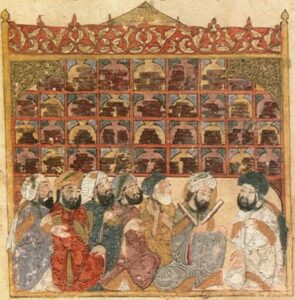
The project investigates how Eastern Christians (East Syriac and West Syriac traditions) engaged with Jews and Muslims in constructing and contesting their collective religious identities in the Arabic-speaking Islamic world between roughly 950 and 1200 CE, a period often called the „Golden Age of Islam.“ While interreligious debates in the Latin West have received substantial scholarly attention, the equivalent discourses conducted in Arabic between the three Abrahamic faiths in the Islamic East remain largely understudied.
Interdisciplinary research methods will be used to investigate how religious identities were constructed, negotiated and remembered in the context of interreligious dialogues and theological disputes. As sources, central works of various literary genres, including apologies, polemics and the Islamic tradition of the Kalām, will be analysed to determine how these interactions contributed to the shaping of the self-conception of each group.
The special religious framework caused by the rule of the Shiite Buyids in Mesopotamia and the Fatimids in Egypt, also enabled representatives of religious minorities to engage in disputes with Muslim scholars on an equal footing. Thus, a completely different dynamic than in Christian Europe emerged, where similar dialogues often took place under coercive and asymmetrical conditions.
Christian philosophers, such as the West Syriac scholar Yaḥyā ibn ˁAdī, were able to rise to become leading scholars in Baghdad’s academic world and gather a multi-religious circle of students around them. The religious controversies that unfolded between him and his Jewish and Muslim colleagues and students show how religious identities were challenged and defended in this academic environment.
Methodologically, the project draws on concepts of identity theory, in particular that of collective identity and social memory, as well as the model of cultural memory developed by Jan and Aleida Assmann.
The aim of this project is to comprehensively analyse how religious controversies shaped collective identities in the medieval Islamic world and to open up new perspectives on the interaction between Jews, Christians and Muslims. The project promises to provide far-reaching new insights into interreligious relations in the Middle Ages and the historical development of religious identity and to add valuable non-European perspectives on the history of Christianity, Islam and Judaism to existing research.
Principal Investigator: Bernhard Kronegger