Functional Materials
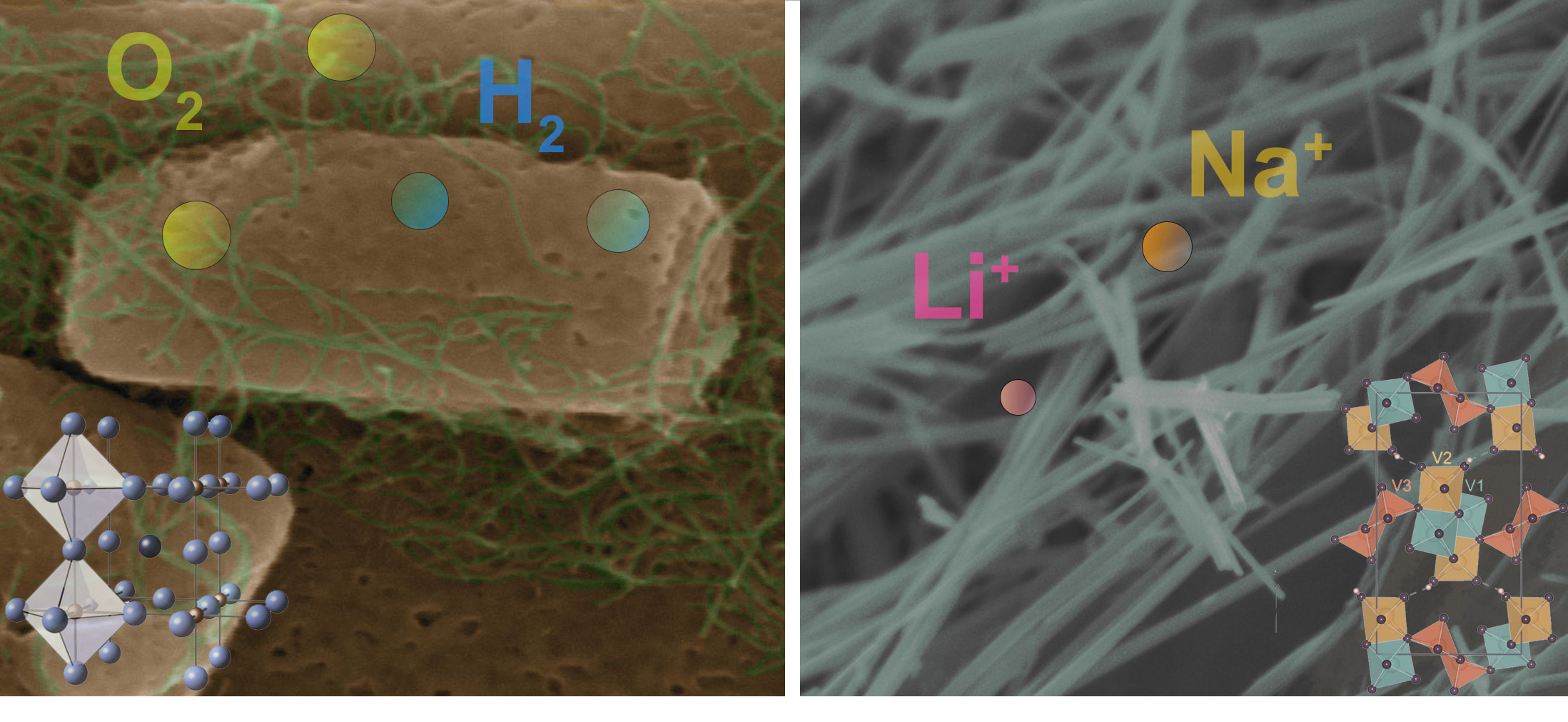
Renewable energy conversion and storage are relevant topics in applied research today, since the use of non-fossil energy sources is essential for the reduction of CO2 emissions. Solar and wind energy harvesting combined with chemical energy storage in batteries or fuels like hydrogen are essential processes, which need to be improved in efficiency, long-term stability and scalability. Our goal is to contribute to the development of cost effective scalable solutions for energy conversion and storage.
Recent news
Oral presentation: „Degradation of oxynitride based photoanodes“
S. Pokrant
76th Annual Meeting of the International Society of Electrochemistry, September 07-12, 2025, Mainz, Germany
Oral presentation: „Towards aqueous full Na-ion batteries: Vanadium-based electrodes in a highly concentrated electrolyte“
J. Lam Chen, S. Pokrant
76th Annual Meeting of the International Society of Electrochemistry, September 07-12, 2025, Mainz, Germany
Poster presentation: „Controlling the pore structure of nanoporous silica scaffolds for silicon-based lithium-ion battery anodes“
S. Pokrant, M. Karl, A. Kalyakina, C. Dräger, and S. Haufe
11th European Silicon Days, July 14-16, 2025, Salzburg, Austria
Group excursion 2025

Poster presentation: „Effect of Cocatalyst Deposition on the Photocatalytic Activity of Oxynitride Particles“

P. Zahabi, J. Praxmair, S. Pokrant
EMRS 2025 Spring Meeting, May 26-30, 2025, Strasbourg, France
Talk: „Salzburger Vorlesungen“
May 6, 2025, Salzburg, Austria


Poster presentation: „In-situ SEM and ex-situ TEM investigations of chemical and physical processes utilizing µReactor technology“
J. Zalesak, L. Novak, R. Tenne, V. Kundrat
15th ASEM Workshop 2025, April 24-25, Leoben, Austria
Further information
Oral presentation: „Hybrid batteries – a concept to boost post-lithium ion batteries“
D. Söllinger, S. Pokrant
4th Conference of the GDCh Division of Chemistry and Energy
Further information
TEM Workshop: „Exploring Structures at the Atomic Scale – New Possibilities in Transmission Electron Microscopy at PLUS“
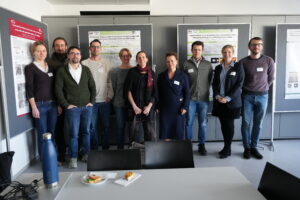
Organizing commitee and invited speakers of PLUS TEM Workshop
February 7, 2025, University of Salzburg, Salzburg, Austria
Latest Publications
Degradation of oxynitride based photoanodes
Julian Hörndl, Jakub Zalesak, Franky E. Bedoya-Lora, Sophia Haussener and Simone Pokrant. Journal of Materials Chemistry A (2026.). https://doi.org/10.1039/D5TA06368J
Hydrothermally Synthesized BiVO4: The Role of KCl as Additive for Improved Photoelectrochemical and Photocatalytic Oxygen Evolution Activity
Jakob Praxmair, Fabrizio Creazzo, Deqi Tang, Jakub Zalesak, Julian Hörndl, Sandra Luber and Simone Pokrant. ChemElectroChem (2025). https://doi.org/10.1002/celc.202500280
Determining the electrochemical properties of SiO2 for the rational design of siliconbased active materials in lithium-ion batteries.
Michael Karl, Christoph Dräger, Alena Kalyakina, Johanna Poschenrieder, Jakub Zalesak, Gregor Zickler, Stefan Haufe and Simone Pokrant. J Appl Electrochem (2025). https://doi.org/10.1007/s10800-025-02368-0
V3O7·H2O as a Cathode Material for Aqueous Mg2+/Na+ Hybrid Electrochemical Cells
V3O7‧H2O as cathode material in an aqueous hybrid cell, upon Mg2+ and Na+ intercalation, reaches an excellent initial specific capacity of 404 mAh·g-1 at a practical current density of 100 mA·g-1. The intercalation mechanism inside the hybrid cell is further investigated by operando XRD, post-mortem transmission electron microscopy measurements and other techniques.
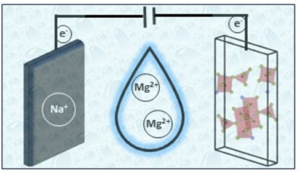
Daniela Söllinger, Julie Lam Chen, Jakub Zalesak, Jakob Praxmair, and Simone Pokrant. V3O7·H2O as a Cathode Material for Aqueous Mg2+/Na+ Hybrid Electrochemical Cells. ACS Omega, 2025. https://doi.org/10.1021/acsomega.4c08983
Stability and degradation of (oxy)nitride photocatalysts for solar water splitting
Advancing towards alternative technologies for the sustainable production of hydrogen is a necessity for the successful integration of this potentially green fuel in the future. Photocatalytic and photoelectrochemical water splitting are promising concepts in this context. Over the past decades, researchers have successfully explored several materials classes, such as oxides, nitrides, and oxynitrides, in their quest for suitable photocatalysts with a focus on reaching higher efficiencies. However, to pave the way towards practicability, understanding degradation processes and reaching stability is essential, a domain where research has been scarcer. This perspective aims at providing an overview on recent progress concerning stability and degradation with a focus on (oxy)nitride photocatalysts and at providing insights into the opportunities and challenges coming along with the investigation of degradation processes and the attempts to improve the stability of photocatalysts.
Valérie Werner, Franky Bedoya Lora, Ziwei Chai, Julian Hörndl, Jakob Praxmair, Sandra Luber, Sophia Haussener and Simone Pokrant, Stability and degradation of (oxy)nitridephotocatalysts for solar water splitting. RSC Sustainability, May 2024. https://doi.org/10.1039/D4SU00096J
Morphological design of LaTiO2N particles by topotactic growth mechanisms for photocatalytic applications

Valérie Werner, Gregor A. Zickler, Simone Pokrant*, Morphological design of LaTiO2N particles by topotactic growth mechanisms for photocatalytic applications. Progress in Solid State Chemistry 2024, Volume 73. https://doi.org/10.1016/j.progsolidstchem.2024.100442
Device Characterization Methods
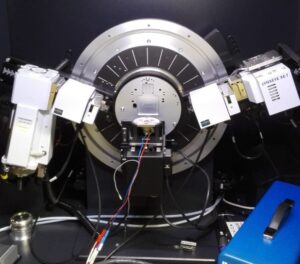
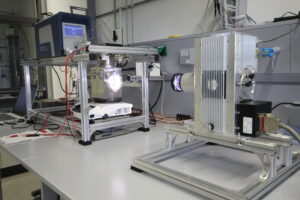
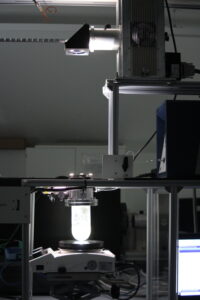
in-operando XRD Faraday efficiency measurement Set-up Measurement set-up for hydrogen and oxygen evolution rates