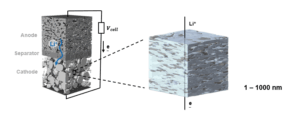
Batteries will be key in our efforts to reduce CO2 emissions but require major progress in sustainability, cost, and energy density. Our research focuses on understanding the interplay between individual materials, multiphase structures, and the overall system properties in future electrochemical energy storage. Systems of interest are supercapacitors, metal-air batteries and metal-sulfur batteries or, broadly, any system with complex physical-chemical phenomena in confined geometry.
Our research is based on
-
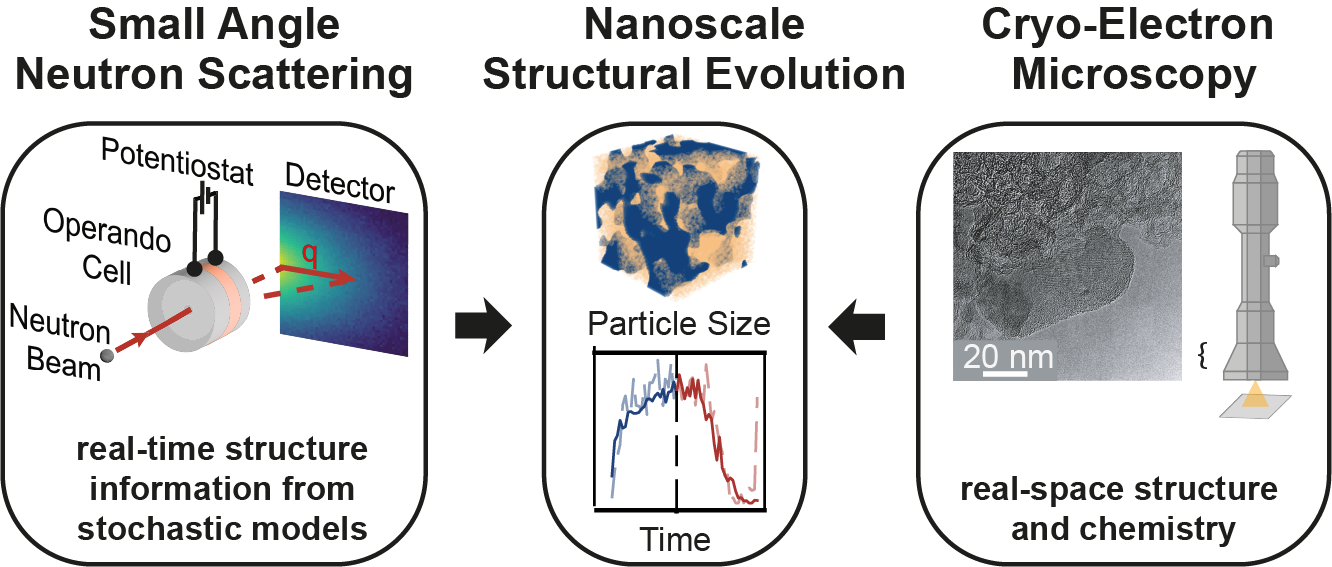
The development of new methods: Operando small angle x-ray/neutron scattering and cryo transmission electron microscopy are combined with stochastic modelling and machine learning for data analysis. Machine learning will be integrated into the experimental workflow of battery testing and in situ experimental testing.
-
The focus on the fundamentals: Electrochemical phase transformation and charge storage mechanisms, as well as structure-property relationships at the nanoscale.
-
A holistic systems materials engineering approach: We aim to put emerging energy storage systems into practice by identifying how the physicochemical interplay of materials across length scales defines overall systems properties. So far, much of the focus to realize post-lithium-ion batteries has been on materials chemistry; We aim to shift the focus on the rational structuring at nanoscopic length scales, to enhance transport and control phase transformation.
News
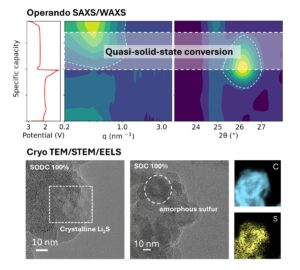
-26/10/2025, New Paper in ACS Energy Letters: Bridging Solution and Solid-State Mechanism in Li–S Batteries: In our latest work, we investigate how sparingly solvating electrolytes (SPSEs) enable a confined “quasi-solid-state” conversion mechanism in lithium-sulfur batteries. Using operando small- and wide-angle X-ray scattering and cryo-TEM, we show that SPSEs promote the coexistence of lithium sulfide and sulfur well beyond the 50% state of charge, highlighting a distinct charge/discharge mechanism compared to solvating electrolytes. The results point to confined polysulfide conversion at the carbon interface, suggesting new pathways for high-rate, high-capacity Li–S batteries with improved stability. [ Link to Paper]
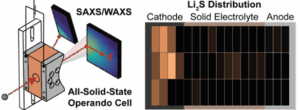
– 01/09/2025, New Paper published in Batteris & Supercaps: Operando SAXS/WAXS of All-Solid-State Li–S Batteries. Understanding the spatio-temporal dynamics of all-solid-state batteries (ASSBs) has been hindered by the lack of operando scattering methods under realistic conditions. In this work, we developed a novel operando cell that enables cross-sectional scanning SAXS/WAXS measurements under high pressure, allowing simultaneous, time-resolved mapping of crystalline phase evolution and nanoscale structural changes across battery layers. [ Link to paper]
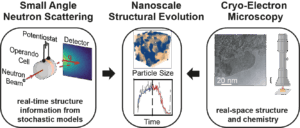
– 01/05/2025, New Paper published in ACS Nano: Synergistic Nanoscale Probing of Li–S Batteries via CryoTEM/EELS and ML-Enhanced Operando SANS. In this work, we combine cryogenic TEM and EELS with operando small-angle neutron scattering (SANS), accelerated by machine learning, to investigate Li-S batteries at the nanoscale. This multimodal approach reveals biphasic discharge products and supports a disproportionation-driven conversion mechanism. The integration of high-resolution imaging with ML-guided neutron scattering sets a new benchmark for probing complex electrochemical systems. [ Link to Paper]
– 01/03/2025, Exciting news! The Energy Materials Lab has secured significant funding through the M-ERA.NET program. In collaboration with the National Institute of Chemistry (NIC, Slovenia), the IWS Fraunhofer Institute Dresden, TU Dresden, and the start-up Sixonia (all Germany), we are launching the project OCULUS. This initiative aims to enhance the rate performance and cycle life of all-solid-state sulfur batteries, driven by detailed insights from operando analytical tools.
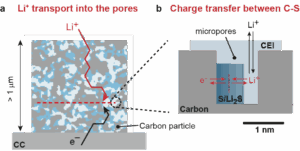
– 01/12/2024, New Paper published in ACS Applied Materials & Interfaces: Understanding Capacity Limitations in Long-Life Li–S Batteries. We report Li–S batteries with long cycle life using nanoporous carbon cathodes and carbonate-based electrolytes. Using operando SANS, XRD, and EIS, we show that primarily charge transfer—not Li-ion diffusion—limits performance. The findings pave the way for higher sulfur loading and improved rate capability. [ Link to Paper]
– May 2024, Research visit to the synchrotron Elettra in Trieste
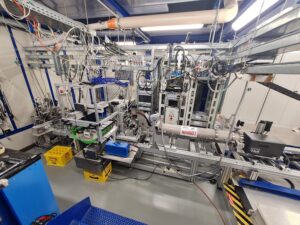
On a weeklong trip to Trieste we tested some of our current lithium-sulfur battery systems at the austrian SAXS beamline. We were able to evaluate a new in-situ SAXS cell setup and gain new insights into the reaction mechanisms of polysulfides in novel electrolytes and cathode materials during charging and discharging.
– 01/2023, ERC Starting Grant SOLIDCON: We are excited to announce that Christian Prehal has received an ERC Starting Grant and 2.37 M Euro funding to work on next-generation lithium-sulfur batteries. The SOLIDCON project will focus on developing new metrologies, advanced data analysis methods, and understanding the fundamentals of solid-liquid-solid and solid-state sulfur conversion. Based on nanoscopic structuring (1-1000 nm), we aim to realize stable high-energy lithium-sulfur batteries. A big thank you to all the supporters in recent years, to the University of Salzburg, and to the European Research Council (ERC) for funding curiosity-driven fundamental research.