





Silhouetted Bodies, Sonic Traces: Troubling In/Visibility of Black On-Screen Presence

Workshop

Students will discuss artistic and cinematic counter-strategies that challenge dominant visual and narrative patterns.

 
Students will become familiar with current theoretical concepts for analyzing In/visibility of black-on-screen presence. They will develop skills in the critical analysis of audiovisual materials from different historical contexts (including colonial sound archives, Nazi-era films, and contemporary documentary cinema). They will reflect on the historical conditions and power relations under which cinematic representations of “Black In/Visibility” are produced and circulate.

13.05.2026, 10.00-14.00 Uhr

2.105 Studio Tanz (UNIPOG2.234)

Unipark Nonntal

Erzabt-Klotz-Str. 1

This interdisciplinary seminar examines how Black on-screen presence in European popular culture is made visible and kept illegible. Often present yet monotonously imagined, Black figures are framed by a dominant gaze and confined to reduced registers of meaning, reproducing harmful tropes.

Moving from Afro-German actors and Black extras in Nazi cinema to contemporary representations of Black individuals in the Parisian banlieues, we will explore questions such as: How can artists construct counter-narratives to hegemonic and harmful racial representations? What new perspectives emerge with some Black extras also recorded in historical sound archives for scientific purposes?

By linking historical film footage with contemporary artistic counter-strategies, the workshop aims to discuss theoretical and methodological approaches to the in/visibility of Black presence across diverse European contexts, beyond conventional frameworks of representation.

The seminar is structured in two parts: a guest lecture followed by a workshop session of film analysis and discussion.

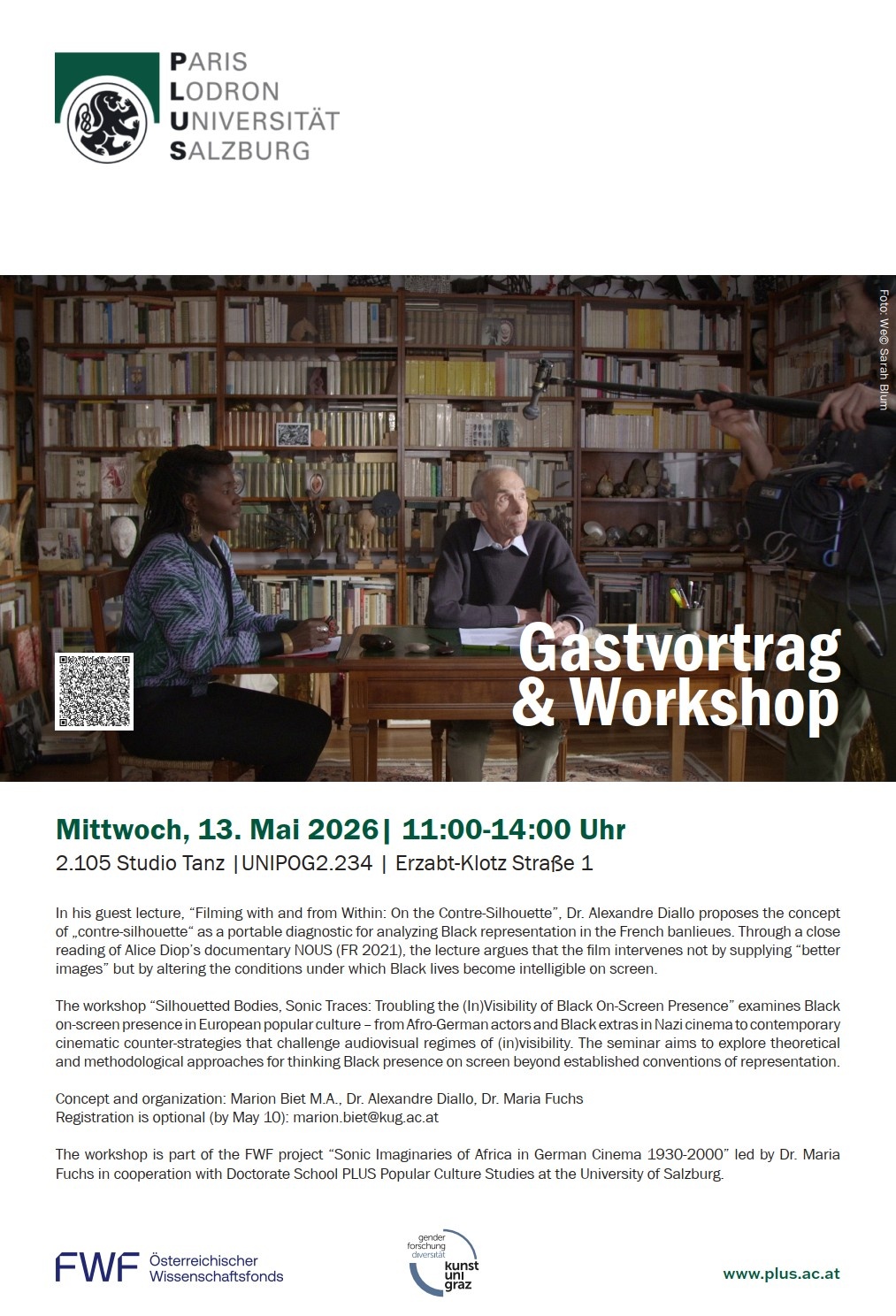
In his guest lecture, titled “Filming with and from Within: On the Contre-Silhouette,” Dr. Alexandre Diallo will propose the contre-silhouette as a portable diagnostic tool for analyzing the representation of Black people in the French banlieues. Through a close reading of Alice Diop’s documentary Nous (2021), he argues that the film intervenes not by supplying “better images” but by altering the conditions under which Black lives become intelligible on screen.

The lecture will be followed by a screening and discussion of historical film material from the Nazi era, focusing on the presence of Afro-German actors and Black extras. Our workshop session on “Silhouetted Bodies, Sonic Traces: Troubling the In/Visibility of Black On-Screen Presence” will be guided by four key concepts: silhouette, counter-silhouette, witnesses of sound, and ventriloquism.

Previous knowledge expected:

Basic knowledge of film, media, or cultural studies is an advantage.

Willingness to engage in the critical analysis of audiovisual media and the discussion of theoretical concepts.

Interest in questions of representation, racism, colonial history, audiovisual archives, and contemporary critical documentary films.