Published on
July 30, 2026
Last update: July 30, 2026
University of Salzburg Confirms Global Trend of Glacier Decline
Measurements conducted in the Stubach Valley provide further evidence of the continuing loss of glacier ice in the Alps and complement recent international research findings.
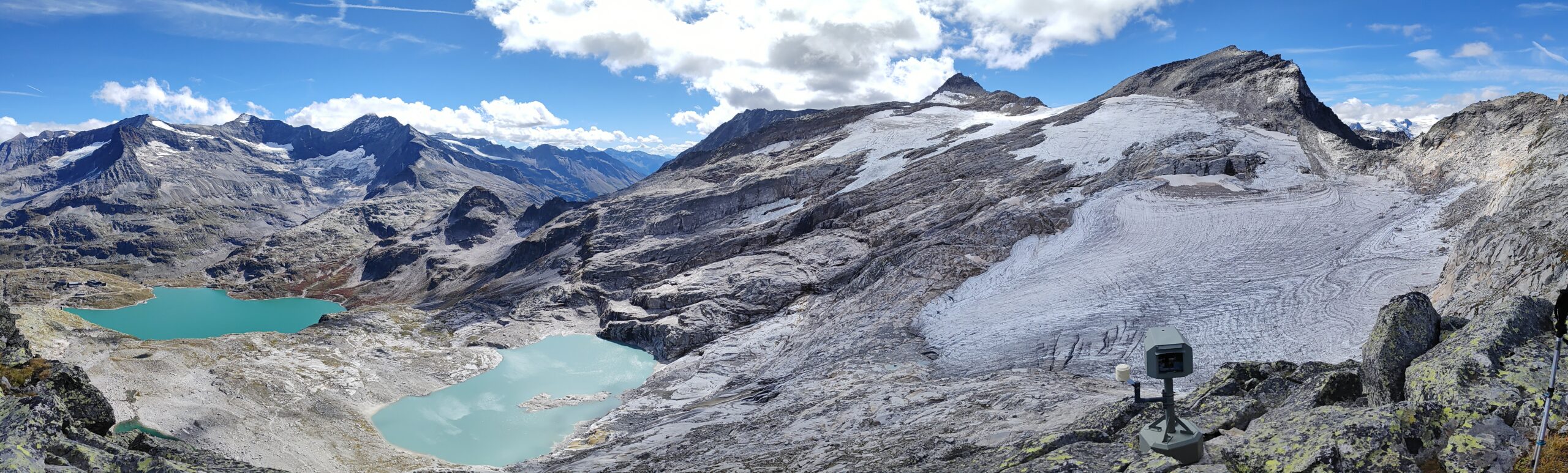
The World Glacier Monitoring Service (WGMS) has released its glacier mass balance assessment for 2025. Both the report’s findings and the long-term glacier monitoring programme conducted by the University of Salzburg at the Stubacher Sonnblickkees glacier highlight the profound impacts of climate change on alpine glaciers.
Global glaciers once again experienced substantial mass loss during the 2025 hydrological year. According to data published by the WGMS, the worldwide net loss amounted to approximately 408 ± 132 gigatonnes, corresponding to an estimated 1.1 mm contribution to global sea-level rise. Central Europe was once again among the regions most severely affected.
Over the longer term, a pronounced acceleration in glacier retreat is evident. Whereas annual losses between 1976 and 1995 remained below 100 gigatonnes, average losses during the most recent decade (2016–2025) reached approximately 390 gigatonnes per year. Cumulatively, global glacier mass loss since 1975 has amounted to almost 9,600 gigatonnes.
Regional observations made by Bernhard Zagel of the Department of Geoinformatics at the University of Salzburg corroborate this global trend:
“The Stubacher Sonnblickkees forms part of a long-term scientific research area in the Upper Stubach Valley. During the 2024/25 balance year, a negative mass balance of –1.27 million m³ was recorded. The principal driver was significantly above-average air temperatures (+1.8 °C). The long-term record reveals a clear trend: of the 45 years monitored since 1981, 38 have shown negative mass balances, while only seven have been positive. In total, approximately 53 million m³ of ice have been lost from the Stubacher Sonnblickkees since 1981.”
The latest findings, produced with the participation of researchers from the University of Salzburg, have been published in Nature Reviews and further underscore the escalating impacts of climate change on both alpine and global glacier systems.
Complementing the global assessment, the recent report “KryoMon.AT – Austria’s Cryosphere Monitoring Programme” documents the alarming condition of Austria’s cryosphere. The national research consortium, which also includes the University of Salzburg, synthesises the latest scientific insights into glaciers, snow cover, permafrost, and lake ice. The report identifies the hydrological years 2022/23 and 2023/24 among the most severe periods of glacier loss ever recorded in Austria. These findings further emphasise the importance of long-term monitoring programmes, such as those undertaken at the Stubacher Sonnblickkees, for advancing our understanding of the impacts of climate change on alpine environments. The report is available through the KryoMon.AT – Austria’s Cryosphere Monitoring Programme platform.