Seminarreihe Umwelt & Biodiversität
Aktuelle Forschung im Fokus: Von Evolutionsbiologie über Ökologie bis zu Klimawandel, Umweltthemen und Biodiversitätstrends.
Die Vorträge sind öffentlich – offen für Uni-Mitarbeitende, Studierende und alle Interessierten.
Die Vorträge für das Sommersemester 2026 befinden sich derzeit in Planung und werden zu Beginn des Semesters hier veröffentlicht.
Nächster Termin:
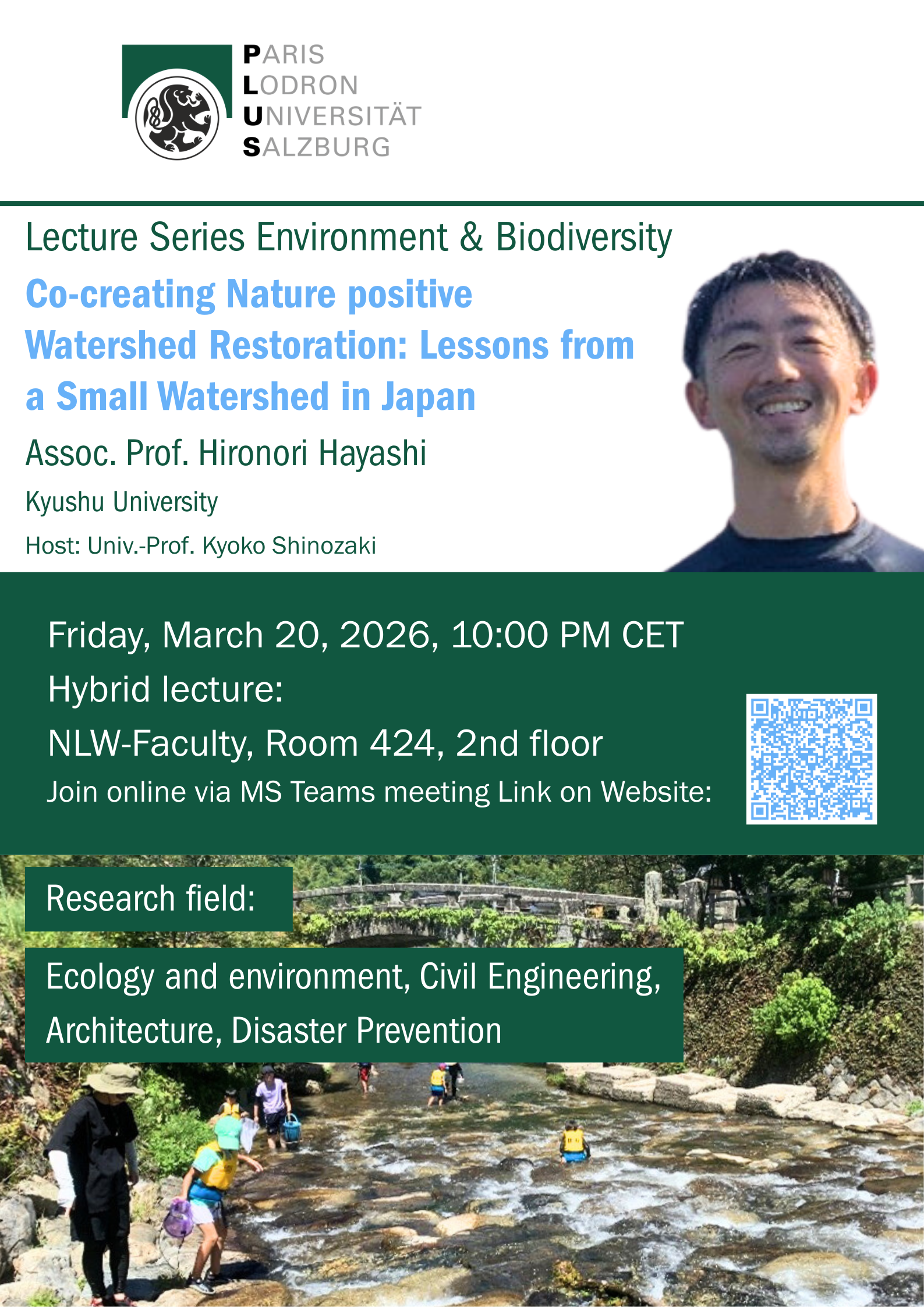 Hybrid-Vortrag
Freitag, 20. März 2026, 10:00 Uhr
NLW-Fakultät, Seminarraum 424, 2. OG
Microsoft Teams meeting:
Join: Microsoft Teams meeting Link
Meeting ID: 320 753 779 650 38
Passcode: GU2W3c8W
Assoc. Prof. Hironori Hayashi, Kyushu University
Co-creating Nature positive Watershed Restoration: Lessons from a Small Watershed in Japan
Freshwater biodiversity degradation has been a critical global challenge, occurring more rapidly than in terrestrial or marine systems. In response to the international goal of achieving “Nature Positive by 2030,” Japan incorporated the social implementation of Nature Positive principles into its national biodiversity strategy. Against this background, our project—supported by the National Geographic Society—conducted a community-driven freshwater restoration initiative in the Notori River basin, a biodiversity hotspot on Kyushu Island, Japan. Focusing on degraded wetlands in the watershed, the project implemented practical restoration measures and scientifically evaluated their effectiveness.
The project consisted of four integrated activities. First, the core activity involved community-led wetland restoration. During the project period, approximately 1,000 m² of wetlands were restored through collaborative fieldwork with local residents and partner organizations. Second, the ecological outcomes of the restoration were quantitatively verified through biodiversity monitoring, which enabled assessment of habitat improvement and species responses. Third, multi-stakeholder workshops were organized to discuss the future vision for a sustainable local community and to raise awareness of freshwater conservation. Finally, the project provided environmental education programs for children, helping to share the value of wetlands and to foster local stewardship. Through these combined activities, the project demonstrated a practical and community-based model for advancing Nature-Positive freshwater restoration in rural Japan.
Über den Vortragenden
Hironori Hayashi is an Associate Professor in the Department of Urban and Environmental Engineering at Kyushu University. He specializes in river morphology and river restoration. In particular, he focuses on the social implementation of river environment conservation and restoration in cooperation with various stakeholders. In his most recent work, he is an Explorer for the National Geographic Society, working on a community-led watershed restoration project in the Notori River Basin. He has extensive practical experience in working with local communities on water environment restoration and has received the JSCE Design Award and the Minister of Education, Culture, Sports, Science and Technology Award in Engineering Education.
Forschungsfeld: Ökologie und Umwelt, Bauingenieurwesen, Architektur, Katastrophenvorsorge
Host: Univ.-Prof. Kyoko Shinozaki
Weitere geplante Termine:
Freitag, 27. März 2026, 14:00 Uhr
Dr. Maria Mashirma Fungomeli, Universität Passau
NLW-Fakultät, Seminarraum 424, 2. OG
Forschungsfeld: Überwachung der Verbreitung von Schmetterlingsarten, Bewertung der Dynamik der Waldvegetation, Schutz und Erhaltung der biologischen Ökologie in den Küstenwäldern Kenias
Host: Valentina Todisco, PhD.
Freitag, 17. April 2026, 14:00 Uhr
City Nature Challenge
Peter Kaufmann, MSc. und Torben Schubert, MSc.
Haus der Natur, Salzburg
NLW-Fakultät, Grüner Hörsaal, EG
Host: Assoz. Prof. Dr. Jana Petermann
Freitag, 24. April 2026, 14:00 Uhr
Dina Dechmann, PD Dr.
Max-Planck-Institut für Verhaltensbiologie
NLW-Fakultät, Seminarraum 421, 2. OG
Forschungsfeld: Anpassungen an vergängliche Ressourcen: Migration, Energiehaushalt, Fledermäuse, Spitzmäuse
Host: Dr. Sophie von Merten
Freitag, 22. Mai 2026, 14:00 Uhr
Sarah Zala, PhD und Priv.-Doz. Dr. Dustin J. Penn
Veterinärmedizinische Universität Wien
NLW-Fakultät, Seminarraum 421, 2. OG
Forschungsfeld: Tierkommunikation und sexuelle Selektion
Host: Dr. Sophie von Merten
Freitag, 29. Mai 2026, 14:00 Uhr
Sophia Rodrigues, Peru
NLW-Fakultät, Seminarraum 434, 3. OG
Forschungsfeld: Gletscher und Vorfelder in den Anden und der Antarktis: Ökologie der Bewohner
Host: Dr. Daniel Remias
Freitag, 12. Juni 2026, 14:00 Uhr
Libor Závorka, Ph.D.
Wasser Cluster Lunz, Lunz am See
NLW-Fakultät, Seminarraum 424, 2. OG
Forschungsfeld: Aquatische Evolutionsbiologie
Host: Prof. Dr. Jana Petermann
Freitag, 19. Juni 2026, 14:00 Uhr
Privat-Doz. Dr. Sabine Hennig
iDEAS:lab, Salzburg
NLW-Fakultät, Seminarraum 413, 1. OG
Forschungsfeld: Bildung für nachhaltige Entwicklung (BNE), Geomedien
Host: Dr. Noreen Mutoro
Montag, 22. Juni 2026, 09:00 Uhr
Vorträge von Studierenden des MSc.- und Diss.-Seminars
Universität Salzburg
NLW-Fakultät, Seminarraum C-006, 3. OG
Host: Univ.-Prof. Dr. Ulrike Berninger
👉 Newsletter abonnieren
Über das Kontaktformular eintragen und keine Termine mehr verpassen!
Rückblick:
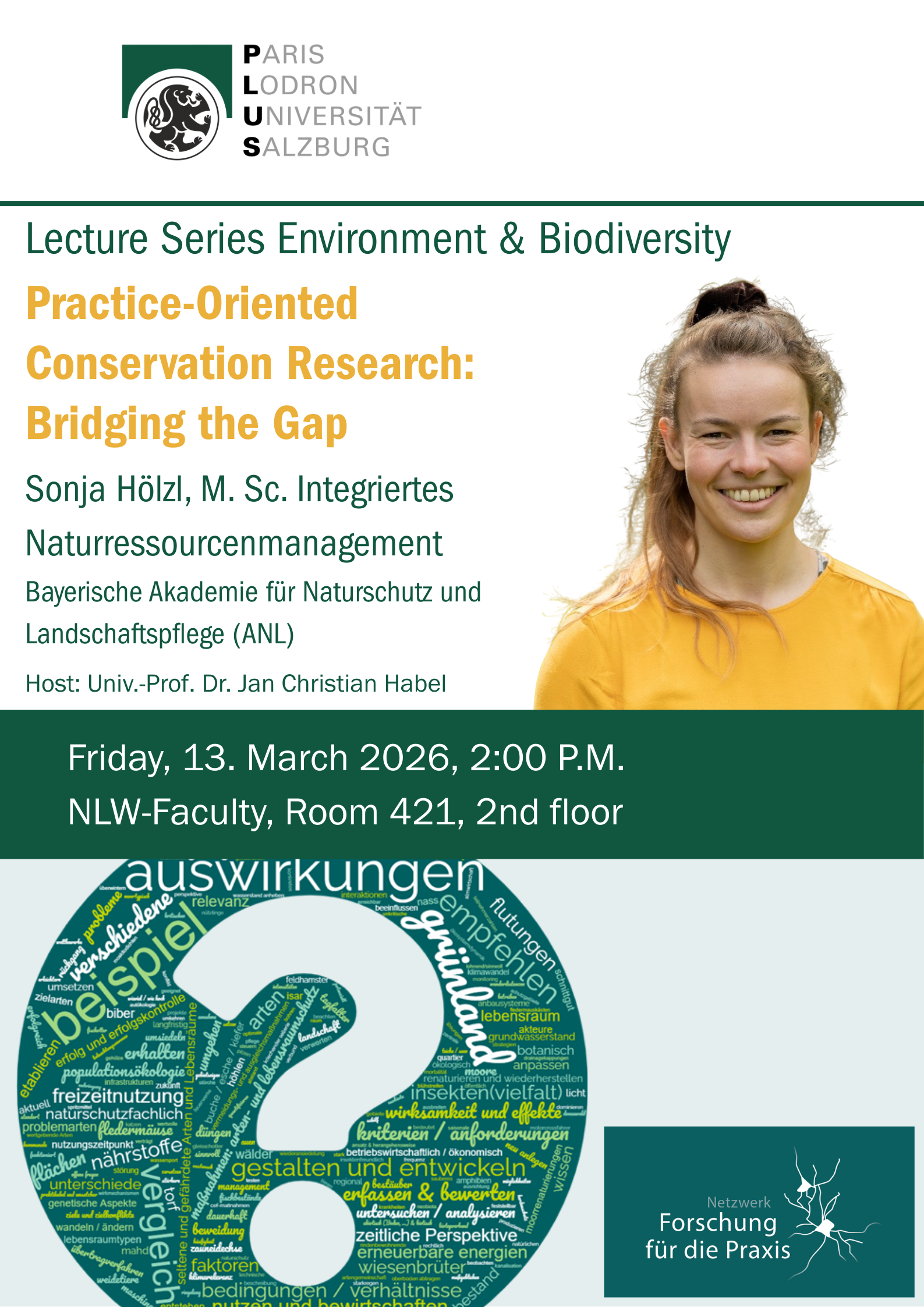 Freitag, 13. März 2026, 14:00 Uhr
NLW-Fakultät, Seminarraum 421, 2. OG
Sonja Hölzl M. Sc. Integriertes Naturressourcenmanagement, Bayerische Akademie für Naturschutz und Landschaftspflege (ANL)
Practice-Oriented Conservation Research: Bridging the Gap
While conservation research reveals how ecosystems function and how they are affected by human action or measures, implementing conservation on the ground often requires additional practical knowledge or the adaptation and clear communication of existing findings. Sonja Hölzl will present the activities of the Bavarian Academy for Nature Conservation and Landscape Management (ANL) at exactly this interface: between research and practice and natural and social sciences. The emphasis of the talk is on bridging the gap between research and practice, and different forms of knowledge. Examples from projects and other approaches will illustrate approaches for practice-oriented research and knowledge exchange, along with challenges and possibilities to address them.
Host: Univ.-Prof. Jan Christian Habel
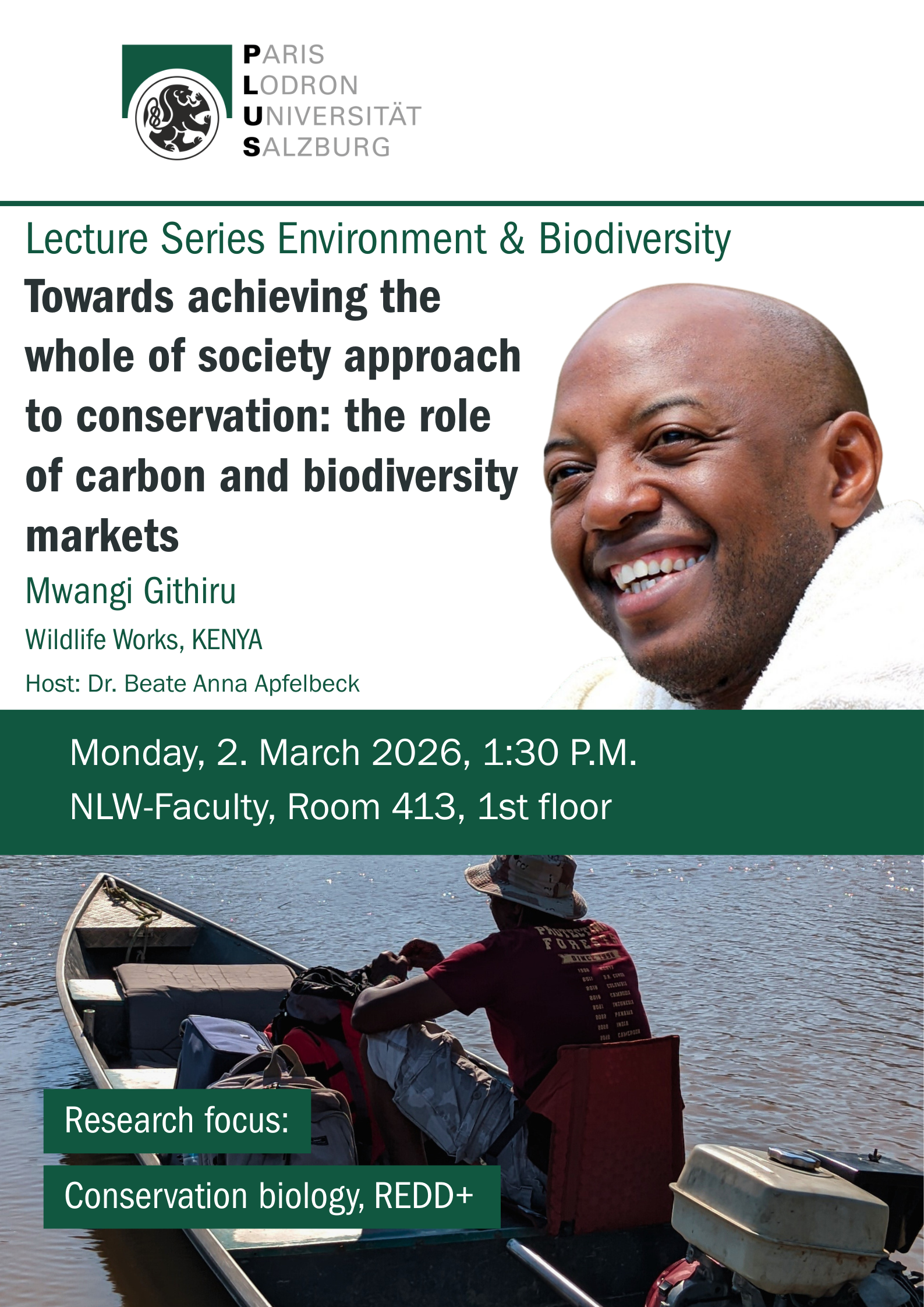
Montag, 2. März 2026, 13:30 Uhr
NLW-Fakultät, Seminarraum 413, 1. OG
Wildlife Works, KENYA
Towards achieving the whole of society approach to conservation: the role of carbon and biodiversity markets
The Kunming-Montreal Global Biodiversity Framework (GBF) aims to halt and reverse nature loss by 2030, with additional 2050 goals. Yet, experience from the 2020 targets plus current patterns of biodiversity threat and loss do not paint a positive outlook for conservation, which is puzzling given all the good intentions and efforts, and the generally growing awareness and financing for the conservation sector. It makes one wonder what it will take to bend the biodiversity loss curve. Wildlife Works is a for-profit conservation organisation that seeks to harnesses the power of market to sustain or improve environmental stewardship. We use the voluntary carbon market as a source of financing to help reduce pressure on tropical forests, improve local livelihoods and drive biodiversity conservation. Recently, we ventured into the biodiversity market, exploring Biodiversity Stewardship Units (BDSUs) as a novel source of financing for rewarding indigenous communities for good stewardship of their forests and biodiversity. This talk will broach how market-driven schemes could help deliver on some of these elusive biodiversity goals, drawing from lessons learnt from our long-running REDD+ projects and nascent BDSU project. I will endeavour to use our current and planned work to draw lessons about moving from theory to practice, bridging disciplines and building linkages for conservation, and hopefully illustrate the role that science and research can play towards realising the plan-globally-but-act-locally notion that will be vital for propelling the whole of society approach advocated by the GBF.
Forschungsfeld: Conservation biology, REDD+
Host: Dr. Beate Anna Apfelbeck
Folge dem FB Umwelt und Biodiversität