KATHARINAfeier 2026
tradition Macht geschichte: Teresa von Avila
The Power to Remember and Interpret a Theologian and Religious Leader
In 1622, Teresa of Ávila (d. 1582) was canonized in Rome alongside four men (including Ignatius of Loyola), with overwhelming support from the Catholic royal houses. The event itself was remarkable, as the Reformation, with its criticism of the veneration of saints, had left its mark to the extent that, compared to the late Middle Ages, there were hardly any canonizations taking place. Only a few decades earlier, Teresa had faced an ecclesiastical inquisition—mainly because of her teachings on prayer, which were suspected of heresy. Her theological writings were not published until after her death in 1588.
Canonizations are always a struggle for control over memory and interpretation. How should saints be inscribed into the memory of the Church? From this perspective, such processes often say more about the historical context and the prevailing ecclesiology of the time than about the canonized person herself. The same applies to hagiographic reception. Drawing on primary sources, this lecture takes Teresa’s canonization as a turning point and first examines her own work as a theologian and religious leader. It then traces the thread of her reception by contextualizing several examples of the later image of Teresa.
When & Where: May 6, 2026, at 5:15 p.m. at the Faculty of Catholic Theology, University of Salzburg, Room HS103; a sermon will follow
About the lecturer:
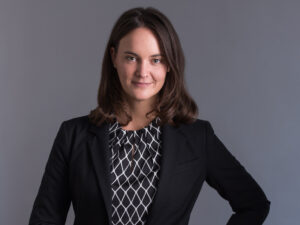
During the 2009–10 winter semester, she initially served as a university assistant (praedoc; covering for a faculty member on educational leave) at the Institute for New Testament Biblical Studies within the Faculty of Catholic Theology at the University of Graz. From 2011 to 2015, she held a position as a university assistant (praedoc) at the Institute for Historical Theology (Department of Theology and History of the Christian East) at the Faculty of Catholic Theology at the University of Vienna. In parallel, she has been active since 2013 as a lecturer in Church History and Eastern Church Studies within the theological courses of the Archdiocese of Vienna and the Austrian Bishops’ Conference.
Between 2015 and 2017, she worked as a research and teaching assistant for the theological courses of the Archdiocese of Vienna, where she also served as the subject representative for church history. From September 2017 to September 2020, she led a third-party-funded research project as a postdoctoral researcher under the Erwin Schrödinger International Fellowship of the Austrian Science Fund (FWF). In this context, she served as a visiting researcher at the Medieval Institute of the University of Notre Dame (USA) in 2017–18, as a guest researcher at the Monumenta Germaniae Historica in Munich in 2018–19, and as a research associate (postdoc) at the Institute for Historical Theology at the University of Vienna in 2019–20. In addition, she held a teaching position in Early Church History and Patrology at the University of Vienna during the summer semester of 2019, as well as a visiting professorship and a teaching position at the University of Regensburg during the winter semester of 2019–20.
During the summer semester of 2020, she served as a lecturer in Church History at the Institute of Catholic Theology at Dresden University of Technology, concurrently with her postdoctoral position in Vienna. From April 2020 to March 2024, she served as head of the Church History department at the Institute of Catholic Theology at Dresden University of Technology. During this time, from March 2021 to March 2022, she served as a visiting professor (W3) in the Chair of Early Church History and Patrology at the Faculty of Catholic Theology at the University of Regensburg (Chair of Prof. Dr. Andreas Merkt) and was released from her duties at TU Dresden for this purpose. Since April 2024, she has been serving as a visiting professor (W3) in the Chair of Medieval and Modern Church History at the Faculty of Catholic Theology at the University of Regensburg.
Information about the KATHARINA Celebration
The KATHARINA Celebration is organized annually by female students, staff, and professors of the Faculty of Theology in collaboration with the Catholic Women’s Movement of the Archdiocese of Salzburg. Since 1990, feminist theology has been brought to the forefront at the University of Salzburg and continually reimagined. The event is organized as a collaboration between the University of Salzburg and various women’s organizations in the city and province of Salzburg.
KATHARINAfeier Team:
Silvia Arzt (KTH Salzburg), Bettina Brandstetter (PH Linz), Roland Cerny-Werner (KTH Salzburg), Clara Grabner (KTH Salzburg), Eva Hartl (KTH Salzburg), Elisabeth Höftberger (KTH Salzburg),
Günter Jäger (KHG), Pia Knödler (KTH Salzburg), Teresa Leonhard (MDW), Sigrid Rettenbacher (PH Linz), Johanna Sacherl (KPH Salzburg), Anne Eve Schurink (KTH Salzburg), Franca Spieß (KTH Salzburg), Angelika Walser (KTH Salzburg)
Contact:Prof. Angelika Walser, Ph.D.
Department of Practical Theology
Faculty of Catholic Theology
Moral Theology and Spiritual Theology
Universitätsplatz 1, 5020 Salzburg
Tel. +43/(0)662/8044-2676
http://www.uni-salzburg.at/Katharinafeier
Foto: ©FotografieHoch2