Event Review
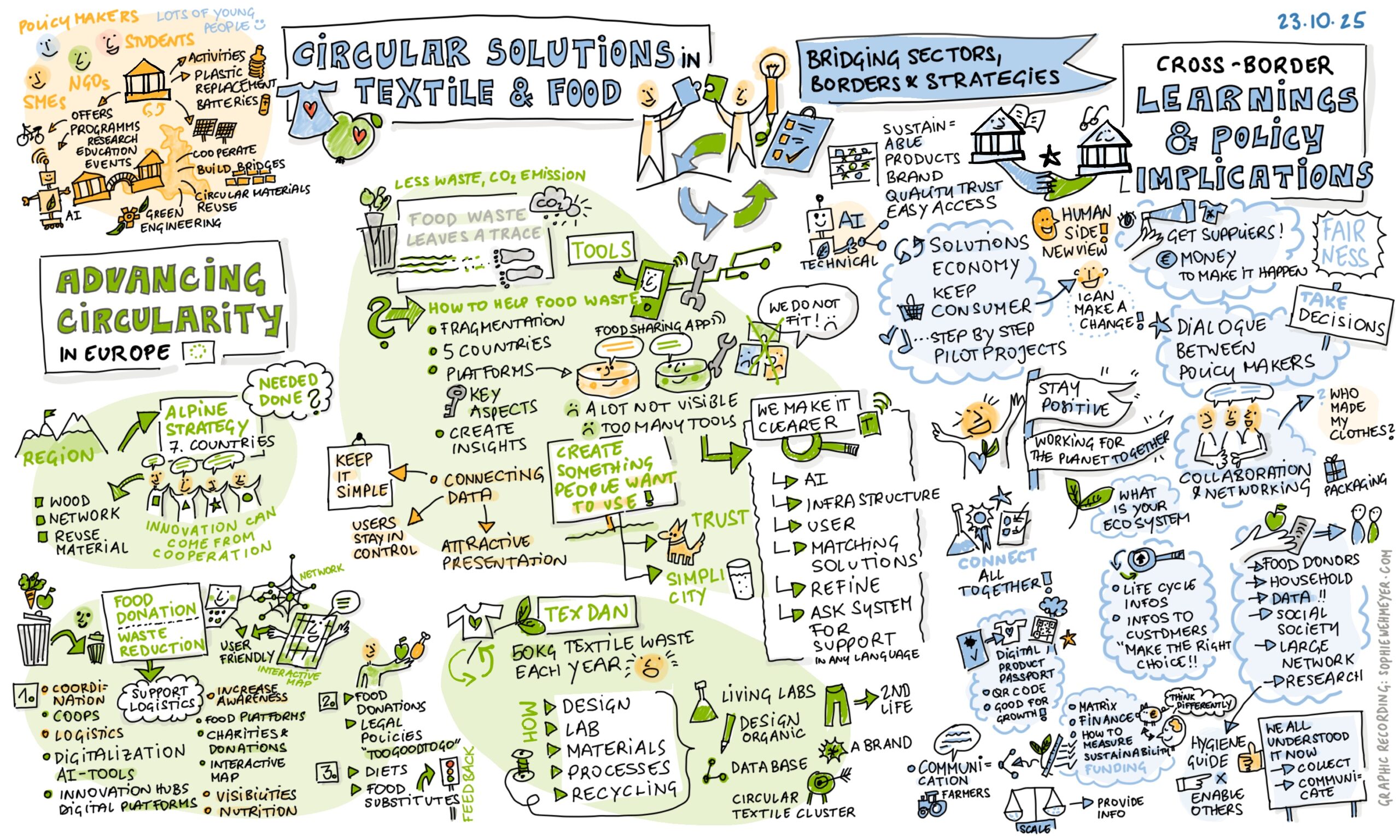
Circular Solutions in Textile and Food
Connecting Sectors, Regions, and Strategies
On October 23, 2025, the Grand Aula of the University of Salzburg transformed into a space for exchange, inspiration, and collaboration.
Under the title Circular Solutions in Textile & Food – Bridging Sectors, Borders & Strategies, students, NGOs, small and medium-sized enterprises, representatives of larger companies, and decision-makers from politics and public administration came together to discuss circular solutions across sectoral and national boundaries.
The event was organized by the University of Salzburg, with contributions from Salzburg University of Applied Sciences and EUSALP. The focus was on how circular economy principles can be practically implemented and interconnected in the textile and food sectors. Central to the event were innovative approaches and outcomes from European projects such as Interreg Austria-Italy FOODIS, Interreg Danube Region TEX DAN, and Interreg Alpine Space CEFoodCycle, which demonstrate how research, business, and society can jointly move toward circular value creation systems. A highlight was the interdisciplinary panel discussion, where representatives from businesses, NGOs, and political institutions shared insights into the opportunities and challenges of cross-sectoral transformation. The discussion made one thing very clear: circularity can only succeed if all actors along the value chain work together on solutions.
From the organizers’ perspective, the evening impressively demonstrated that circular design and surplus management are no longer visions of the future – they are already shaping real business models. At the same time, it became evident that cross-sectoral collaboration is the true driver of circular transformation. Cooperation between business, science, politics, and civil society is essential to bring innovation potential into practice.
Despite all progress, one central challenge remains: circular products and services are still at a disadvantage compared to linear alternatives, as existing market structures and political frameworks continue to favor resource-intensive production methods. Therefore, it is crucial to accelerate the shift from voluntary incentives and support programs to binding standards and clear accountability mechanisms in order to firmly anchor circularity in the economic system.
The role of universities as bridge-builders was also particularly evident: they create spaces where science, politics, and practice can engage in dialogue and contribute to embedding circular innovations in society.
The event concluded with a Circular Tasting & Testing, where participants could experience, taste, and discuss circular products – a sensory finale that showed sustainability can be not only necessary but also inspiring and enjoyable.
To conclude, a quote from the organizers: “We are incredibly proud and grateful for the openness, energy, and dialogue that was palpable that evening. It was a strong signal that real transformation begins where sectors, disciplines, and people come together in conversation.“