NEWS
-

Why construction waste won’t turn into a gold mine
Why Waste is not Automatically Value: Lessons from Circular Economy Research
Recent debates on circular economy and bio-based value creation often assume that residual materials can be readily transformed into economic opportunity. Our empirical evidence shows that waste does not become a resource by default. Value creation from residual materials depends on the alignment of material conditions, institutional frameworks, and business model logics. In practice, this alignment is often missing.
Our recent research on waste valorization in material-intensive industries demonstrates three recurring challenges.
🎯 Material constraints
Residual materials are heterogeneous, geographically dispersed, and often contaminated. Availability, quality, and timing rarely match industrial demand.
🎯 Institutional fragmentation
Regulations, standards, and subsidies are frequently inconsistent or contested. Without regulatory clarity and shared definitions of what counts as “circular,” investment risks remain high.
🎯 Business model misfit
High logistics costs, limited market demand for secondary materials, and weak price signals undermine value capture, even when recycling is technically feasible.
The key insight is sobering but necessary: Circular economy is not about maximizing utilization, but about selective valorization under systemic conditions.
Rather than asking “How can we monetize waste?”, a more productive question is:
Under which institutional, material, and organizational conditions does waste actually become valuable?
Only by addressing these conditions jointly across policy, markets, and value chains can circular economy move beyond symbolic narratives toward structurally viable models.
Has your interest been sparked? Then you can find more information in the original paper and in the podcast.
_____________________________
Image credit: iessephoto on pixabay.com -
Project Completion – We Did It!
The CEFoodCycle project has been successfully concluded.
The project identified resource-saving potentials for defined product categories (such as fruit and vegetables, meat, and dairy products) through the consolidation of life cycle assessment (LCA) standards. Based on data on food production and consumption and the associated CO2 emissions, a digital service system was developed. Using artificial intelligence (AI), it connects actors within (e.g., farmers, food retailers, restaurants) and outside the food stream (e.g., social organizations, food banks, bioenergy producers) and enables them to identify optimization potentials for closing food loops in a transparent manner as well as to monitor food waste and CO2 emission reductions.
The concrete project results include:
(1) Alpine-wide consolidation of the LCA methodology for defined food product categories,
(2) An Intelligent Digital LCA Service System (IDLCASS) that helps users assess decisions regarding resource and CO2 savings (FoodCycle.ai),
(3) Implementation of intelligent networks for closed food loops,
(4) Regionally established Circular Food Hubs that recruit, train, and support stakeholders to make the impacts of AI system–based decisions more sustainable, transparent, and measurable.
The Circular Food Hub Salzburg – Bavaria supports regional companies in identifying potentials to reduce food waste and achieve CO2 reductions. Learn more at Circular Food Hub Salzburg – Bavaria about:
— the online tool FoodCycle.ai,
— a successfully implemented pilot action,
— extensive information and educational materials.
______________________________________________
Image credit: geralt on pixabay.com -
Review: Circular Solutions in Textile & Food
Connecting Sectors, Regions, and Strategies
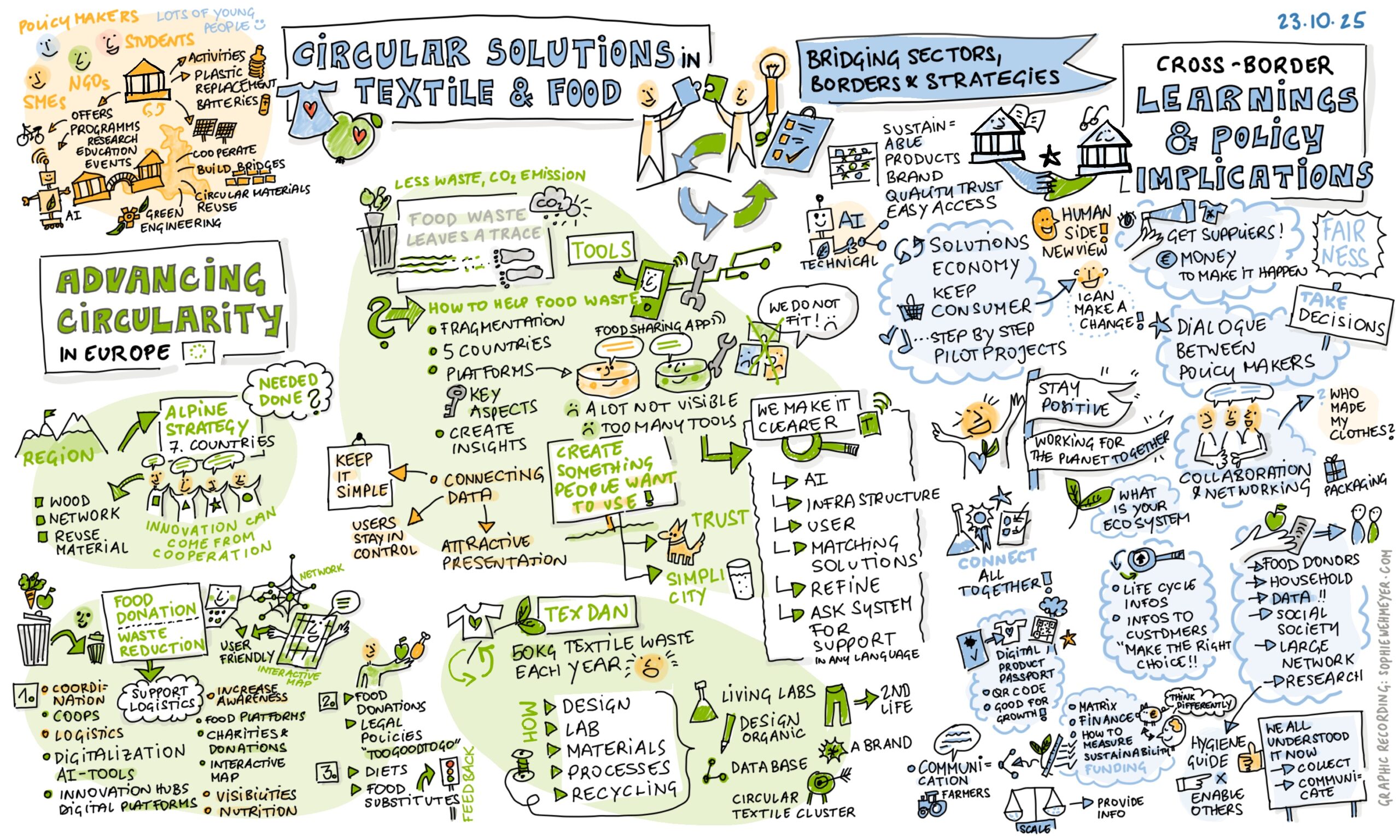
On October 23, 2025, the Grand Aula of the University of Salzburg transformed into a space for exchange, inspiration, and collaboration.
Under the title Circular Solutions in Textile & Food – Bridging Sectors, Borders & Strategies, students, NGOs, small and medium-sized enterprises, representatives of larger companies, and decision-makers from politics and public administration came together to discuss circular solutions across sectoral and national boundaries.
The event was organized by the University of Salzburg, with contributions from Salzburg University of Applied Sciences and EUSALP. The focus was on how circular economy principles can be practically implemented and interconnected in the textile and food sectors. Central to the event were innovative approaches and outcomes from European projects such as Interreg Austria-Italy FOODIS, Interreg Danube Region TEX DAN, and Interreg Alpine Space CEFoodCycle, which demonstrate how research, business, and society can jointly move toward circular value creation systems.
A highlight was the interdisciplinary panel discussion, where representatives from businesses, NGOs, and political institutions shared insights into the opportunities and challenges of cross-sectoral transformation. The discussion made one thing very clear: circularity can only succeed if all actors along the value chain work together on solutions.
From the organizers’ perspective, the evening impressively demonstrated that circular design and surplus management are no longer visions of the future – they are already shaping real business models. At the same time, it became evident that cross-sectoral collaboration is the true driver of circular transformation. Cooperation between business, science, politics, and civil society is essential to bring innovation potential into practice.
Despite all progress, one central challenge remains: circular products and services are still at a disadvantage compared to linear alternatives, as existing market structures and political frameworks continue to favor resource-intensive production methods. Therefore, it is crucial to accelerate the shift from voluntary incentives and support programs to binding standards and clear accountability mechanisms in order to firmly anchor circularity in the economic system.
The role of universities as bridge-builders was also particularly evident: they create spaces where science, politics, and practice can engage in dialogue and contribute to embedding circular innovations in society.
The event concluded with a Circular Tasting & Testing, where participants could experience, taste, and discuss circular products – a sensory finale that showed sustainability can be not only necessary but also inspiring and enjoyable. -
Marketing at a Turning Point
Positioning Waste as a Valuable Resource
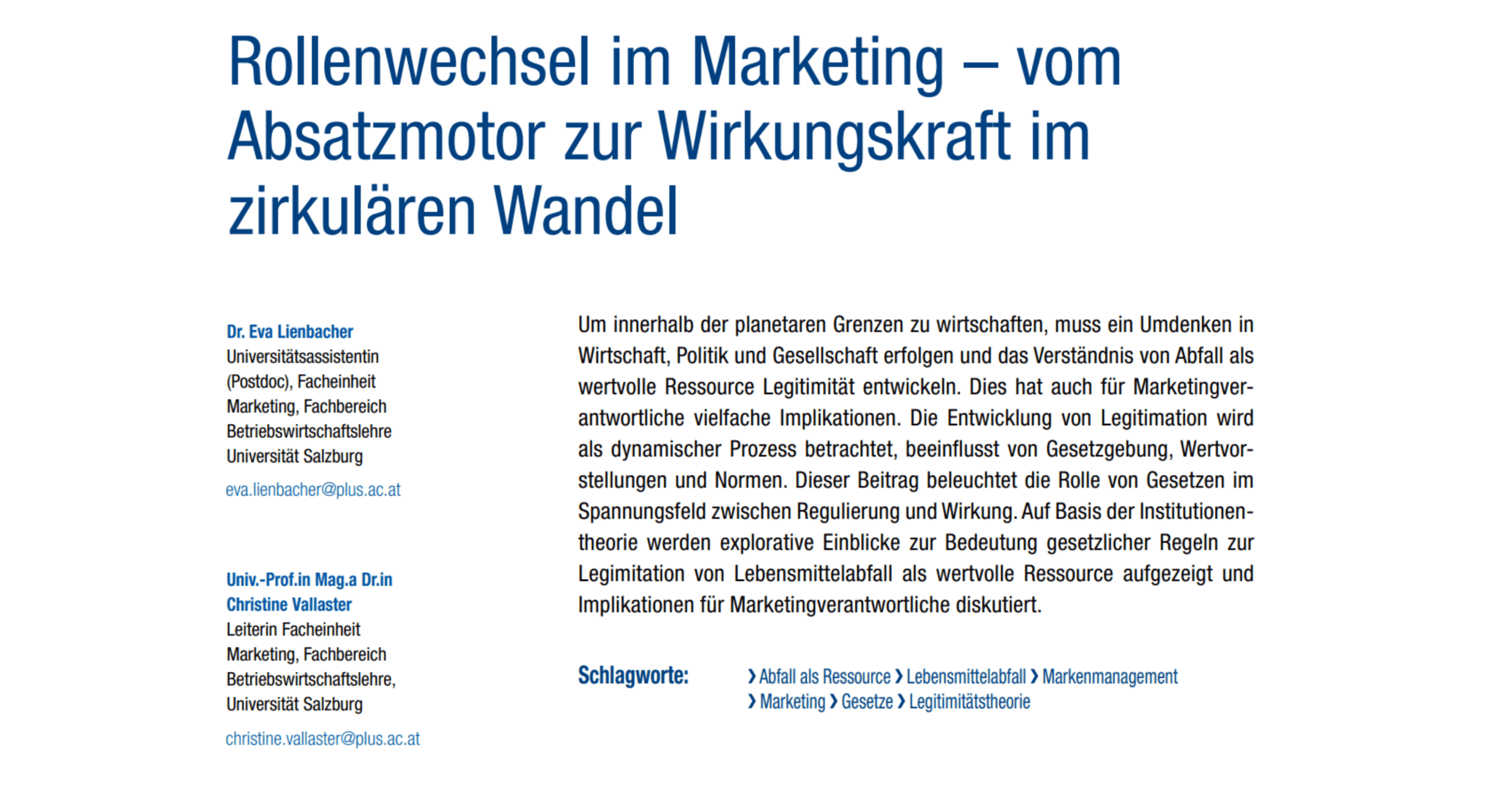
While topics such as sustainability, ecological responsibility, and the climate crisis are increasingly fading from public discourse—and forces like the oil lobby and right-wing parties are reviving outdated mindsets—we at the University of Salzburg are deliberately taking a stand. Through our research at the Marketing unit, we view marketing not merely as a driver of sales, but as a resonance space for change. This perspective was picked up by transfer – Journal for Communication and Brand Management, and we are proud to contribute to this dialogue:
🚀 Marketing at a Turning Point: From Sales Engine to Architect of Change 🚀
What if we no longer saw food waste as “garbage,” but as a valuable resource? Our study shows: legislation alone rarely creates legitimacy. The real power lies in cultural narratives, lived values, and bold brands.
Three uncomfortable truths:
1️⃣Legal regulations lag behind—often still trapped in linear logic.
2️⃣Start-ups with circular thinking struggle against entrenched structures.
3️⃣Marketing must do more than “tell green stories”—it must create new meanings.
👉 The future of marketing means:
Building legitimacy, generating resonance, transforming culture.
The full article is available in transfer – Journal for Communication and Brand Management (accessible via the University of Salzburg’s library). -
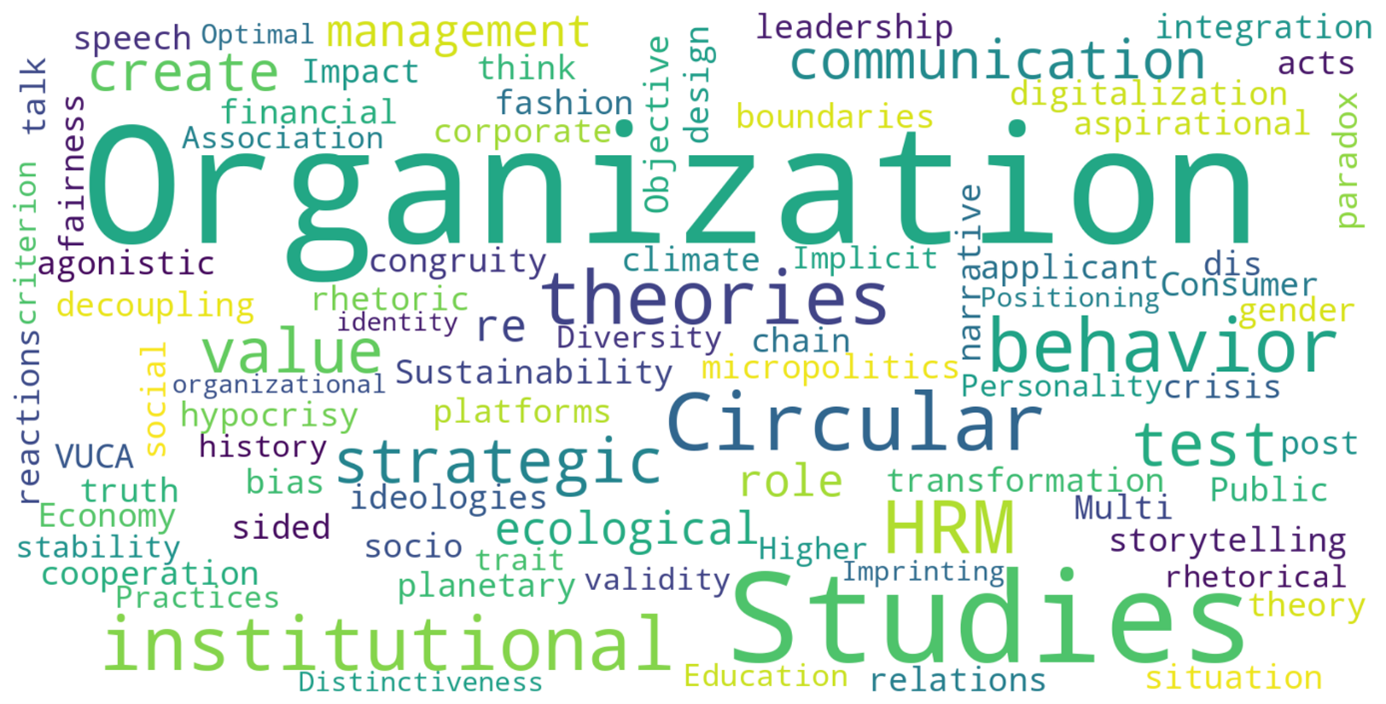
Image credit: AI generated DSP College for Organization Studies
The Marketing Unit is a member of the DSP for Organization Studies.
The Doctoral School PLUS (DSP) “Organization Studies” is a research platform at the Paris Lodron University of Salzburg that focuses on the institutional expectations and demands placed on organizations and their responses to these.
Through interdisciplinary collaboration and a broad theoretical foundation from the fields of organizational and management research, communication science, psychology, and consumer behavior, the DSP “Organization Studies” examines the central role of organizations and organizational practices in shaping and adapting to dynamic challenges in business and society. A key goal of the DSP is to empirically test and further develop existing organizational theories.
The five research focuses of the DSP for Organization Studies are:
– Adoption of Structures and Practices
– Circular Economy and Organizations
– Psychological Diagnostics
– Human Resource Management (HRM)
– Organizational Communication
For more information, please visit the DSP College for Organization Studies page. -
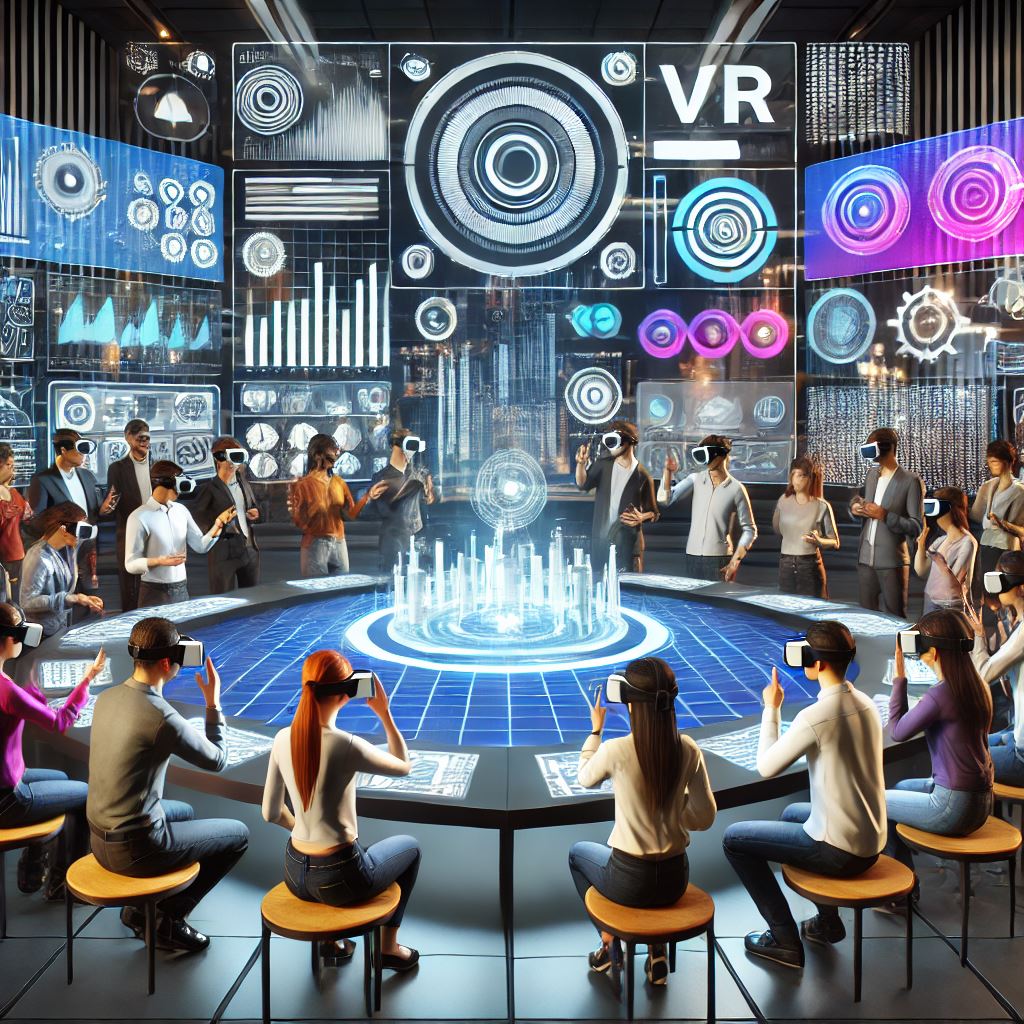
Image credit: AI generated Articel in the Journal of Retailing and Consumer Services
„Interactive product presentation in an immersive environment: The
influence of functional control on hedonic aspects“ von A. Kinzinger, W. J. Steiner, M. Tatzgern und Ch. Vallaster
Functional control in webshops allows consumers to virtually experience the different functions of a product. To date, however, the potential benefits of enabling functional control in online product presentations in addition to standard visual control have only been studied and proven for non-immersive virtual environments but not for immersive virtual reality shopping experiences in webshops. We close this research gap by comparing an immersive product presentation format with visual control (grabbing a product and viewing it from different angles) to that of an immersive product presentation format with additional functional control (experiencing and inspecting the different functionalities of the product) by means of a between-subjects experiment. Our special focus is on the influence of functional control on the hedonic aspects of online shopping since interactive immersive webshops are known to offer particular potential to enhance the hedonistic shopping experience of consumers. Our findings suggest that (1) the possibility to try out product functions in an immersive environment can significantly increase the shopping experience of consumers and that (2) hedonic aspects like the enjoyment of consumers actually seem to play a highly important role in immersive webshops. Accordingly, as a practical implication of our study, companies should consider investing in functional control elements when presenting their products in immersive virtual reality webshops as a way to gain a competitive advantage.
You can find the full article at this link.