SALZBURG ENGLISH CONFERENCES
Call for Papers and Workshops:
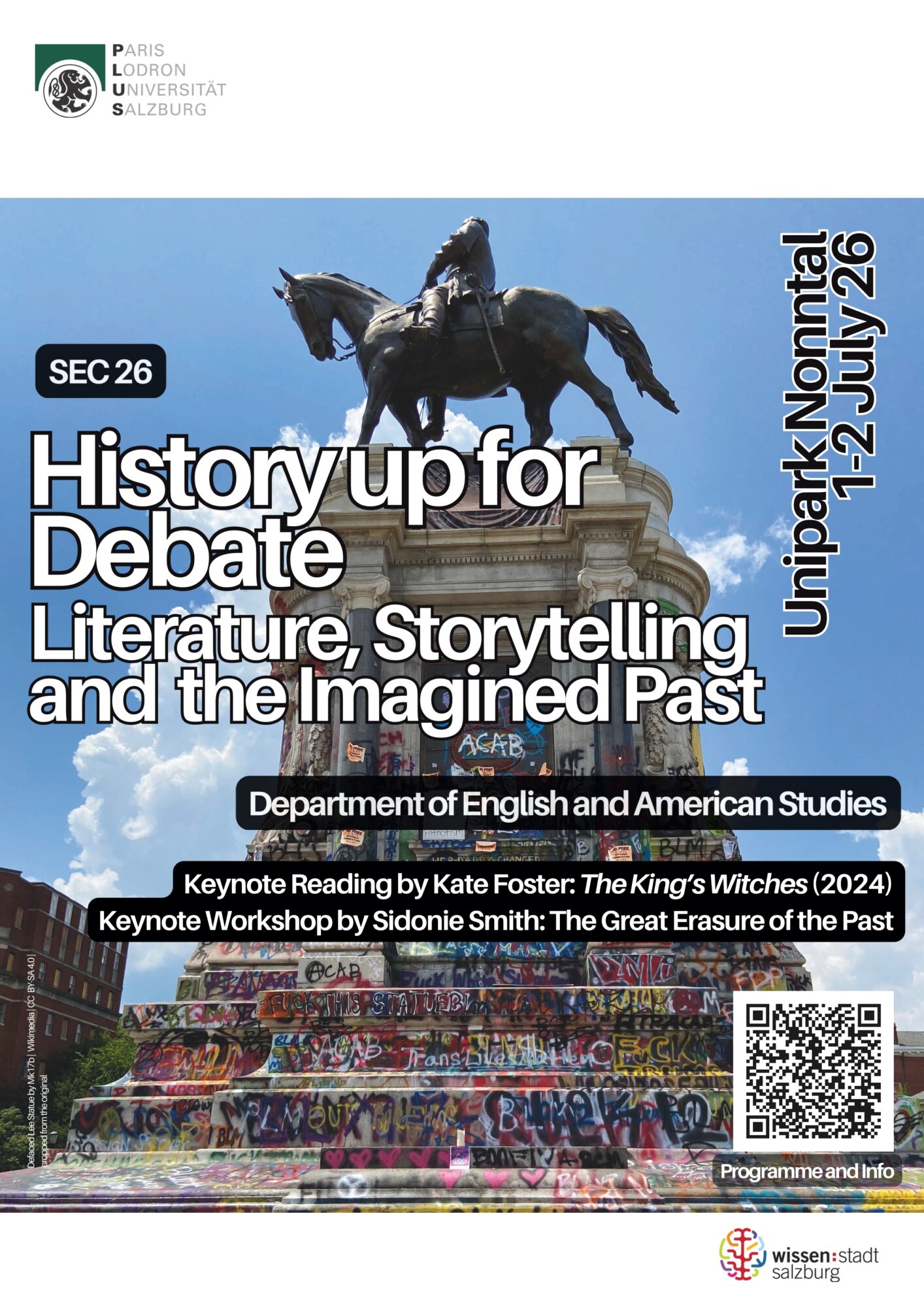
“History up for Debate: Literature, Storytelling and the Imagined Past | SEC26”
1-2 July 2026, University of Salzburg, Department of English and American Studies, Unipark Nonntal
Conference within the Framework of the Salzburg Conferences on English Literature and Culture (SEC)
Organisers: Dorothea Flothow, Julia Hartinger, Sarah Herbe, Christopher Herzog, Eva-Maria Kubin, Markus Oppolzer, and Elisabeth Schober
The Call for Papers is closed. Acceptances have gone out. Registration for the conference ended on 28 May.
The CONFERENCE PROGRAMME is now available: Click here
Original Call for Papers:
Given that the past, and the narratives and stories we shape of it, seem thus particularly contested and controversial at the present moment, this conference aims to explore the literary and filmic narratives (in the form of historical novels, costume drama, documentaries, life writing, biofiction, biopics, etc.) in which we shape history for the wider public and the ends to which these are used. Based on the assumption that storytelling is not only a fundamental way in which humans orient themselves in the world but also a potent means of shaping reality, these narratives’ role as a means of creating a desirable present and future will also be examined.
The conference thus aims to examine various aspects of storytelling and the past. We want to look at specific examples of how the past is shaped to fit the present, for instance, to shape and confirm (national) identities, to support liberal or conservative gender roles, or to substantiate political claims and agendas. In addition, we would also like to explore the specific attractions and advantages that different genres may offer to this end, for instance, by seemingly suggesting greater ‘truth effects’ (cf. Frow 2005: 2) or, as studies on the flourishing genre of biofiction highlight, by offering a more imaginative access by speculating on historic characters’ thoughts and feelings (see e.g. the articles in Boldrini et al. 2025).
As it is organised by the Department of English and American Studies at the University of Salzburg, the conference focuses particularly on English-language novels, drama, performance, films, TV series and various forms of life-writing, but we also welcome examples from other countries, languages and historical cultural traditions with the end of exploring the manifold popular uses of the past. Equally, we are interested in both contemporary and historical examples of politicised uses of the past in popular historical forms.
Part of the conference is dedicated to workshops for teachers focusing on how accounts and narratives of the past shape our understanding of history that examine strategies to help students question representations of the past, reflect on different perspectives, and connect historical themes to contemporary issues.
Topics may include, but are not limited to:
– (national) myths and nation-building in historical literatures
– resurrecting marginalised voices
– present and historical uses of (identity) politics in historical novels, period drama, biography, biofiction, etc.
– re-telling / staging past resistance (literary and theatrical renderings of significant protests, political movements, etc.)
– historical imaginings as a means of resistance and subversion
– historical storytelling and genre
– processes of remembering and forgetting / literary dementia studies and memory
– historical storytelling and memory
– the ethical dimensions of fictionalizing the past: invention vs. accuracy
– documentary theatre and verbatim theatre: staging the ‘true’ past
– intersections of myth, folklore, and historical accounts
– genre boundaries: historical fiction, autofiction, speculative and alternative histories
– the role of desire in shaping representations of the past
– embodied past in performance
– the role of paratext in historical fiction (afterwords, author’s note, inclusion of archival material, …)
– historical storytelling and the archive
– the use of the past (e.g. documentary, mockumentary, historical fiction, television, and film) in the (language) classroom
References
Boldrini, Lucia et al. (2025). The Routledge Companion to Biofiction. Routledge.
Frow, John. (2005). Genre. The New Critical Idiom. Routledge.
Henneböhl, Dennis. (2023). Taking Back Control’ of the Nation and Its History? Contemporary Fiction’s Engagement with Nostalgia in Brexit Britain. Inter/Media 21. Brill.
Jordanova, Ludmilla. (2010). History in Practice. 2nd ed. Arnold.
Noakes, Lucy. (2023). War and the British: Gender, Memory and National Identity 1939-1991. Revised Edition. Bloomsbury Academic.
Submission is closed! Proposals (max. 250 words) for 20-minute papers or 90-minute teacher workshops with a short bio note (max. 150 words) were due 2nd February 2026. Papers and workshops must be presented in English.
In case of questions, please contact:
Further information and the preliminary programme will be available soon.