News from the Center
-
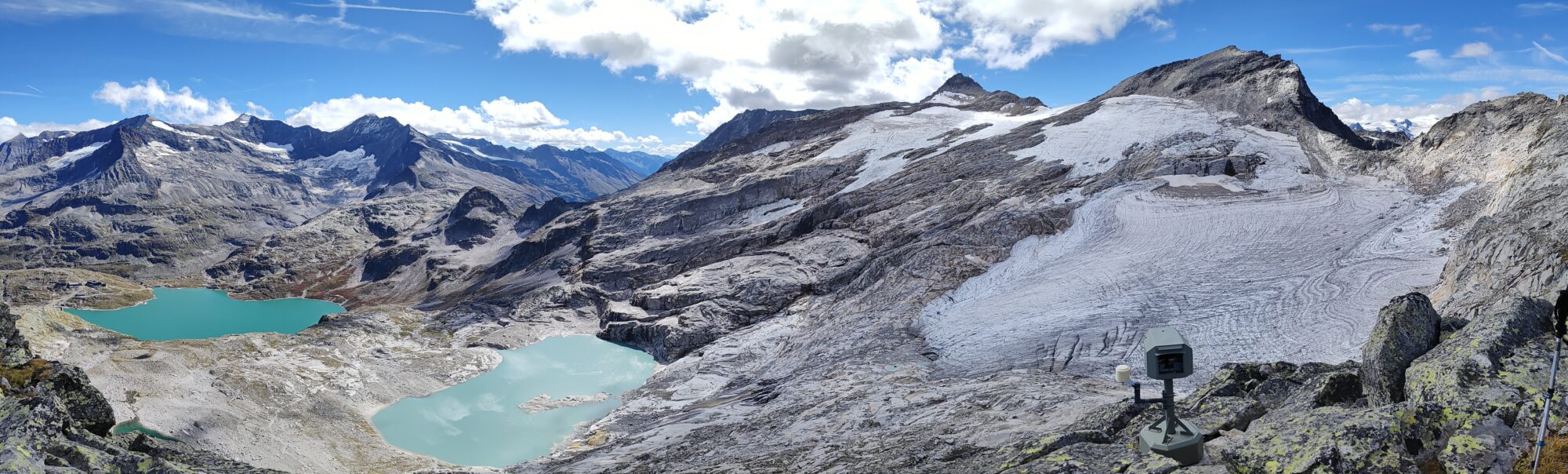
Photo credit © Bernhard Zagel Glacier Retreat
University of Salzburg Confirms Global Trend
Measurements conducted in the Stubach Valley at the Sonnblickkees glacier provide further evidence of the ongoing loss of glacier ice in the Alps and complement current international research findings published by the World Glacier Monitoring Service (WGMS).
The latest research results, involving scientists from the University of Salzburg, have been published in the international scientific journal Nature Reviews and in the current national report by KryoMon.AT, Austria’s cryosphere monitoring program.
Bernhard Zagel from the Department of Geoinformatics explains his scientific observations: “The Stubacher Sonnblickkees forms part of a long-term scientific research area in the Upper Stubach Valley. During the 2024/25 balance year, a negative mass balance of –1.27 million m³ was recorded. The principal driver was significantly above-average air temperatures (+1.8 °C). The long-term record reveals a clear trend: of the 45 years monitored since 1981, 38 have shown negative mass balances, while only seven have been positive. In total, approximately 53 million m³ of ice have been lost from the Stubacher Sonnblickkees since 1981.”
Further information on this topic can be found here if you are interested! -
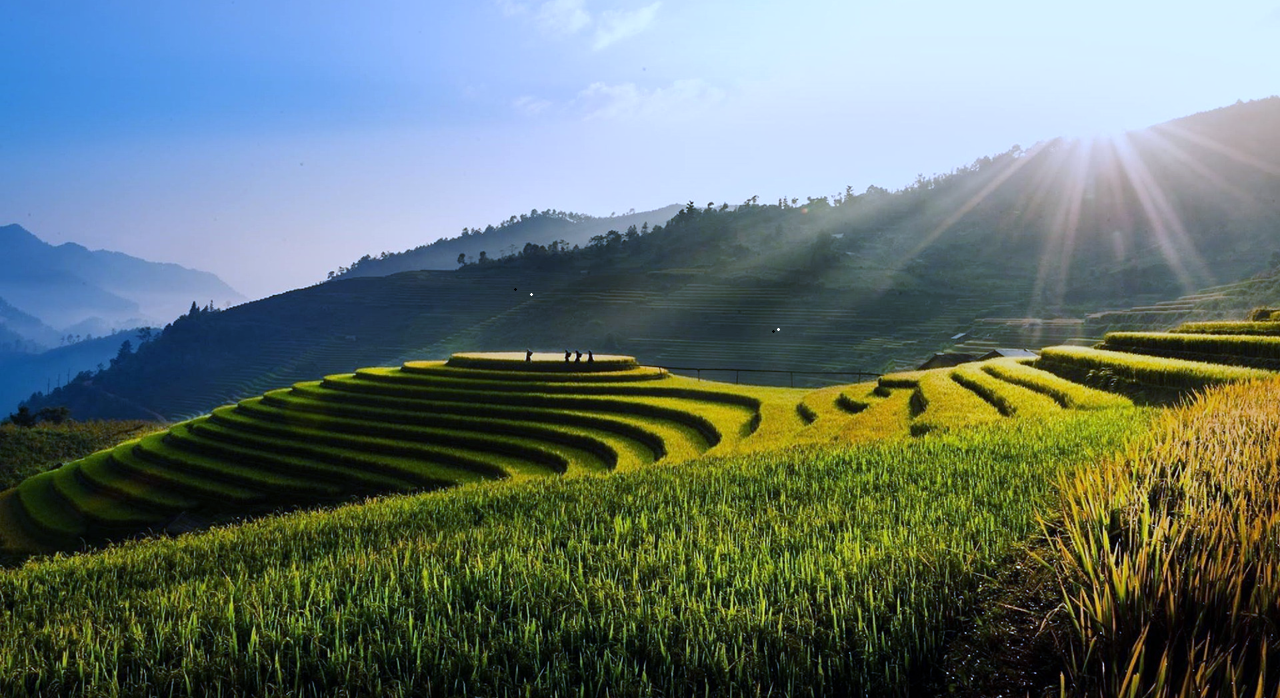
Image credit: motlancuoi2018 on pixabay.com Terrace Construction as a Climate Strategy
Carbon Sequestration in Soils
Agricultural terraces are widespread in mountainous regions around the world. They reduce soil erosion, improve soil water balance, and support agricultural production. Since soils represent the most important terrestrial carbon reservoirs, terracing is increasingly being used as a land-use technique to store carbon and thus mitigate anthropogenic global warming. However, the scientific findings to date are mixed. The creation of terraces can lead to both the storage of carbon in the soil and its loss from the soil: soil characteristics and climatic conditions play a decisive role in this process.
The new study Coupled geomorphic and climate-driven biogeochemical processes regulate soil organic carbon stocks in agricultural terraces by an international group of researchers from Belgium, Norway, Switzerland, the United Kingdom, Italy, China, and the University of Salzburg, published in the prestigious journal “Science Advances,” demonstrates how climate influences the balance between soil displacement and carbon stabilization and, for the first time, provides a comprehensive framework for understanding carbon dynamics in agricultural terraces. A key contribution to this understanding came from comparing terraced and non-terraced landscapes across a wide climatic gradient.
This comparison shows that terraces accumulate carbon in humid regions, whereas in (semi-)arid regions they can actually lead to carbon loss. The study thus demonstrates that land-use strategies must be adapted to regional conditions: climate, soil properties, and land management collectively determine whether terraces are suitable for long-term carbon sequestration (while also increasing food production and reducing soil erosion as a “side effect”).
For the head of the CC:R Center, Univ.-Prof. Jussi Griessinger, this study exemplifies how the CC:R Center generates internationally relevant scientific insights for mitigating the impacts of climate change.
The research for the study was funded as part of the EU project TerrACE (ERC Grant No. 787790). The project leader at the University of Salzburg was Prof. Andreas Lang from the Department of Environment & Biodiversity. -

Image credit: sasi-tha on pixabay.com Cooperation between CC:R and 2030Green
Applying technologies directly – that is the goal of the cooperation between CC:R and 2030Green
Three selected projects from 2030Green and the University of Salzburg will deliver tangible and immediate added value for a sustainable economy and society.
2030Green project Climb: The Melting Cryosphere – Impacts on Water Availability and Water Quality in Mountain Regions
The disappearance of glaciers is one of the consequences of current global warming. Projections show a significant loss of glaciers across all mountain regions. Some areas, such as the European Alps, are expected to lose 100% of their glacier cover by the end of the century.
Using AI‑based analyses, key variables for explaining sediment fluxes will be identified. In a second step, glacier evolution models driven by global climate models will be used to predict future ice‑free areas and to assess future catchment conditions and sediment flows for high‑mountain regions worldwide. This will provide a solid foundation for water management in regions that will soon be affected by glacier retreat.
2030Green project SoilTreeCC: A Dual Approach to Carbon Sequestration
Soil fertilization with weathering products and the resulting increase in biomass production in mountain regions – this research project applies a novel interdisciplinary method. It investigates a natural dual CO₂ storage approach aimed at enhancing atmospheric CO₂ sequestration using soils and trees in mountain environments
2030Green project Bio Response: The Persistence of Biodiversity in Times of Climate Change
Climate change is causing dramatic alterations in biodiversity. The degree to which organisms can adapt to rapidly emerging climatic changes is central to their survival. For butterfly species, there is abundant knowledge regarding past and current geographic distributions, ecological requirements, and behavior.
In a first step, potential changes in butterfly communities along the alpine altitudinal gradient will be examined. In a second step, adaptive capacity to rapidly occurring environmental changes will be analyzed at both the phenotypic and genetic levels.
-
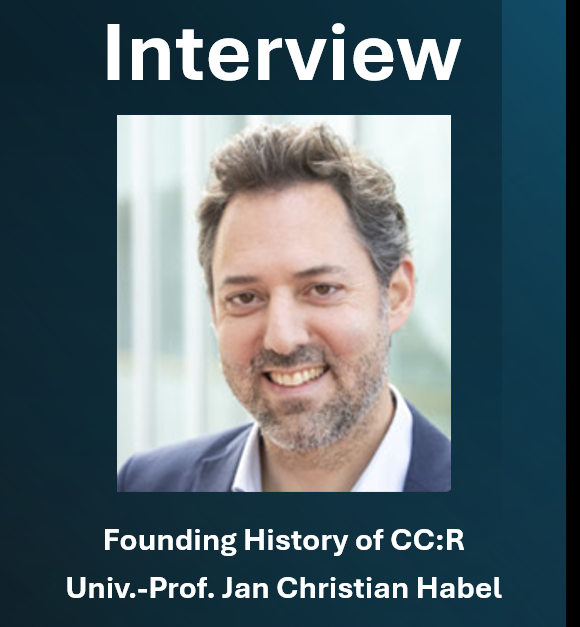
Center for Climate Change Resilience (CC:R)
Founding History
Published in Umwelterklärungen – Universität Salzburg
Mr. Habel, answering complex questions often requires a transdisciplinary approach. Can you explain how a new center at the University of Salzburg is intended to promote exactly this linkage of disciplines?
Jan Christian Habel: The new center, which we established in 2024, aims to strengthen transdisciplinary approaches in research and teaching. It is called “Climate Change Resilience” and is dedicated to the resilience of systems in the context of climate change. Climate change affects not only nature but also our lives in many ways. Increasing weather extremes and slow-onset climatic changes lead to profound alterations in the systems and processes of our environment. As a result, stressors for organisms and entire systems increase, threatening the functional integrity of environmental processes.
You speak about resilience. What exactly does this term mean in this context?
Jan Christian Habel: Resilience describes the capacity of a system to return to its original state after a disturbance. This is crucial to ensure that essential environmental functions—and ultimately functions important for human wellbeing—can be maintained in the future. In the climate debate, the resilience of systems is therefore of central importance. Our goal is to better understand how ecological systems, as well as humans, can become resilient in order to meet the challenges of climate change.
How is the center structured, and who will be involved?
Jan Christian Habel: The center is deliberately designed to be interdisciplinary. Researchers at the University of Salzburg work together with experts from non-university institutions. Because climate change and system resilience occur on very different spatial and temporal scales and affect all areas of the living and non-living environment, we have assembled a founding team from various disciplines. These include fields such as biology, geosciences, chemistry, physics, statistics, artificial intelligence, economics and social sciences, and psychology. This diversity enables us to examine the topic from multiple perspectives and develop innovative solutions.
What concrete goals is the center pursuing?
Jan Christian Habel: Our aim is to strengthen transdisciplinary research on climate change and resilience at the University of Salzburg. We plan to achieve this, among other things, by submitting consortium-based project proposals. At the same time, we want to integrate the topics of climate change and climate resilience more deeply into academic education. Furthermore, the center will serve as a communication platform—both within the university and between the university and external partners such as society, business, and politics.
We have already achieved a first success by launching a cooperation with the international foundation Green 2030. The foundation is supporting three research projects that have already begun, in which colleagues address the following questions:
– How does climate change affect biodiversity and the functioning of ecosystems?
– What impact does the melting of glaciers and permafrost have on water quality and water availability?
– How can changes in vegetation contribute to increasing carbon storage?