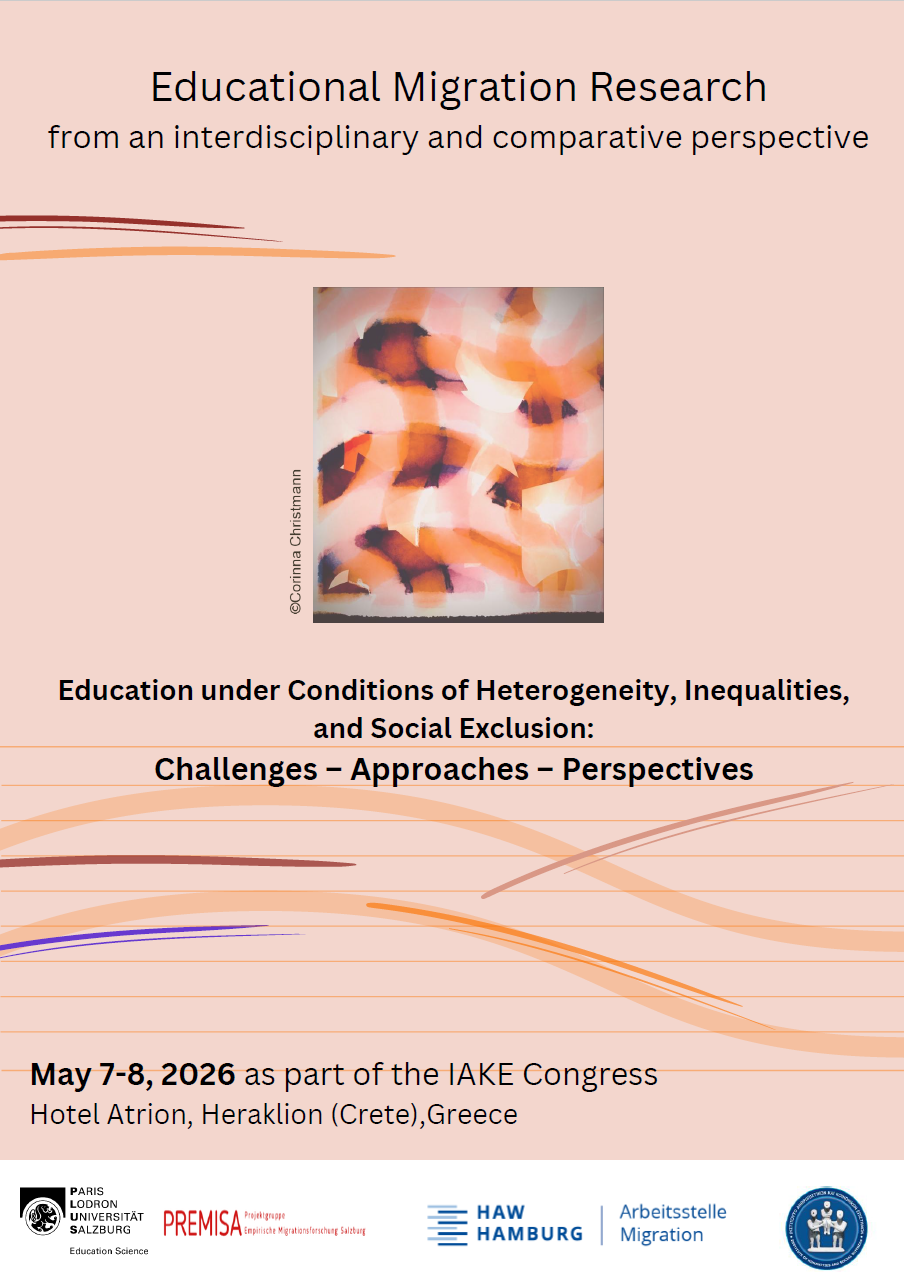
Symposium
Educational Research on Migration
from an Interdisciplinary and Comparative Perspective
Theme: Education in the context of heterogeneity, inequalities and social exclusion.
Challenges – Approaches – Perspectives
Heraklion (Crete), Greece, 7–8 May 2026, as part of the IAKE Congress
The symposium ‘Educational Research on Migration from an Interdisciplinary and Comparative Perspective’ aims to examine current trends and topics in educational research on migration from an international, comparative, theoretical and empirical perspective, as well as to explore different academic perspectives on current migration-related issues and beyond. In addition, the symposium aims to provide a forum for discussing new research approaches and identifying potential applications in educational practice and policy.
This year’s thematic focus centres on ‘Education under conditions of heterogeneity, inequalities and social exclusion’, such as those arising from refugee migration, precariousness, discrimination, stress or social and institutional processes of exclusion, as well as their consequences for educational trajectories and opportunities for participation. The complexity of this subject area also requires interdisciplinary and intersectional perspectives. How heterogeneity is socially constructed and addressed, and how it manifests itself along migration-related lines of difference in specific forms of education-related inequality and mechanisms of exclusion, is the subject of educational migration research.
These conditions do not merely operate at a structural level; they also shape and determine subjective perceptions, emotional experiences and intergenerational educational processes. Injustices give rise to moral emotions: outrage, shame, indignation or empathy. Such emotions open up avenues of understanding regarding experiences of inequality or can mobilise forms of solidarity. This highlights the potential of emotion research as a hitherto under-exploited approach within the context of educational migration research, enabling moral concern in the face of injustice to be viewed not merely as an individual reaction, but as a dimension relevant to educational theory. Furthermore, experiences of inequality and exclusion are significant across generations. Intergenerational educational research provides a key insight into this: it shows how experiences of exclusion, belonging or marginalisation can be passed on, reinterpreted or transformed. Educational settings are subject to processes of social division; they can either reinforce or mitigate these divisions. It is therefore of interest to analyse how, to what extent and under what conditions educational institutions actually fulfil their non-discriminatory commitment to equal opportunities for all, not merely in theory but in practice. Against this backdrop, the 2026 Symposium invites participants to theoretically refine, empirically explore and methodologically reflect on the theme of ‘Education under conditions of heterogeneity, inequalities and social exclusion’. The focus is on five thematic areas, which are not to be understood in isolation from one another, but rather as intertwined perspectives on education under conditions of inequality and exclusion.
1. Research into inequality
2. Educational equity
3. Moral emotions
4. Transgenerational educational research
5. Intersectionality
Information about the venue: Atrion Hotel, Heraklion (Crete), Greece
The conference is being organised as part of the 12th International Scientific Conference of the I.A.K.E. (Institute of Humanities and Social Sciences, Heraklion, Crete, 7–10 May 2026) and will take place on the island of Crete, Greece.
The symposium will take place on the hotel premises.
Accommodation can be requested at the Atrion Hotel. Alternatively, we recommend staying near the conference venue, for example at the Kastro Hotel.
We look forward to welcoming you to Crete!
Entry fee: €50.00 (payable on the day)
Call for Papers Deutsch Englisch
Programme
In addition to the academic programme, a varied social programme – including cultural evenings and an excursion – has been organised in cooperation with the 12th International Scientific Conference of the I.A.K.E. (Institute of Humanities and Social Sciences, Heraklion, Crete, 7–10 May 2026).
On Sunday 10 May, we invite you to join us on an excursion, which offers the opportunity to explore the region and chat with other participants in an informal setting.
Further details on the supporting programme will follow!
Tickets for the cultural evenings and the day trip can be purchased on site.
Contact persons
Organisers
Prof. Dr. Wassilios Baros, Chair of Educational Research, Paris Lodron University of Salzburg, Department of Educational Science, Erzabt-Klotz-Str. 1, 5020 Salzburg
Prof. Dr. Louis Henri Seukwa, Chair of Educational Science, HAW Hamburg, Faculty of Social Work and Early Childhood Education, Alexanderstraße 1, 20099 Hamburg
Registration and paper submissions via email to the organising team:
Dr. Aida Kell-Delić, BA MA
Annika Wastl, BA
Yannic Viertl
We look forward to your participation and wish you a safe journey!
International Symposion
Childhood and Social Policy
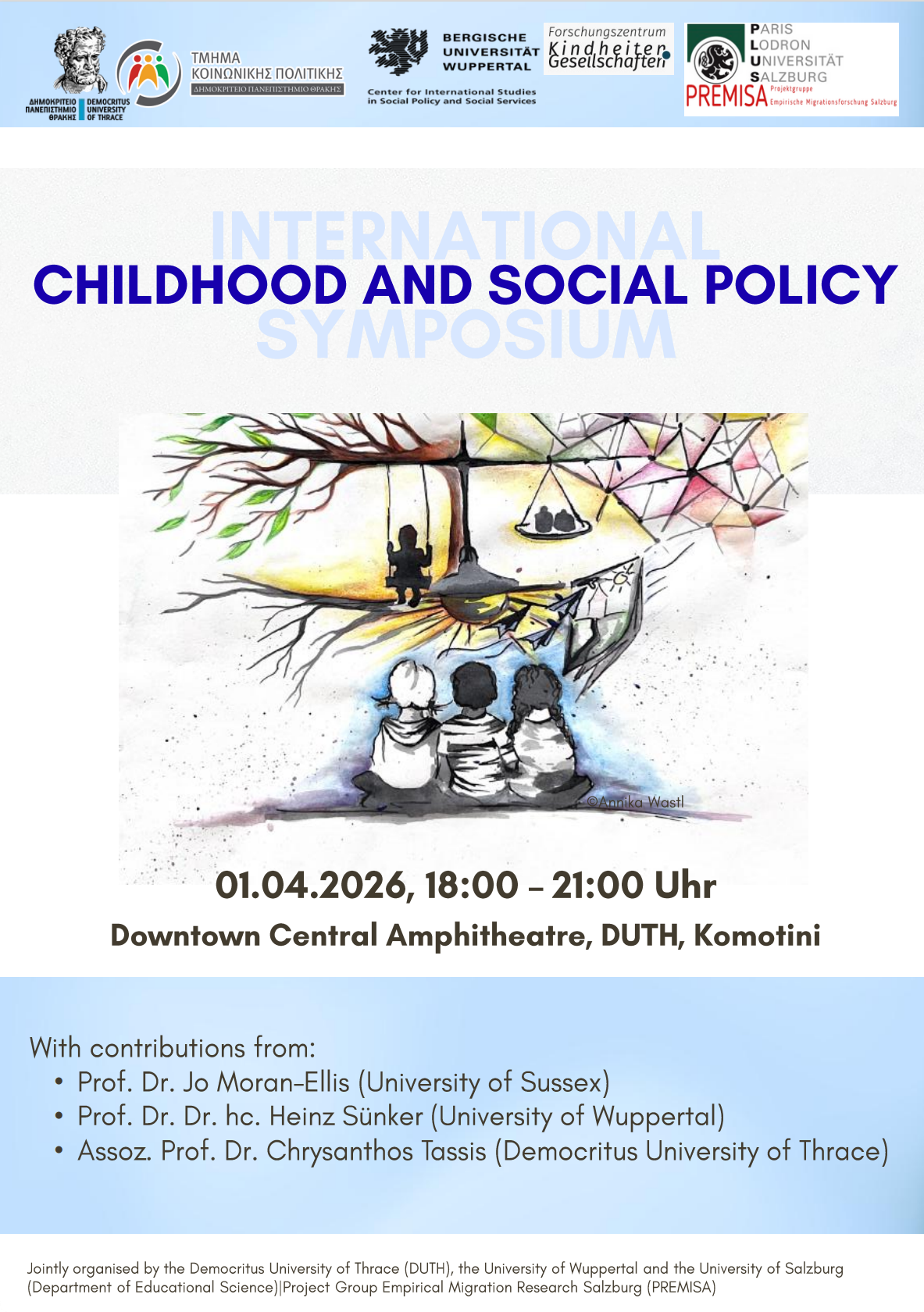
1 April 2026
6.00 pm – 9.00 pm
Downtown Central Amphitheatre
Democritus University of Thrace (DUTH), Komotini, Greece
Start-up
Preamble
The Department of Education and Professional Research, as an organisational unit within the Faculty of Education, is establishing the course “Hellenic Studies ‘Gaberell & Angeliki Drachman’” for academic continuing education in accordance with Sections 118, 119 and 120 of the Statutes of the University of Salzburg. Univ. Prof. Dr. Wassilios Baros is responsible for the academic, financial and organisational management of the course.
1. Course content and teaching approach
The course ‘Hellenic Studies “Gaberell & Angeliki Drachman’ provides a comprehensive insight into the language, culture and history of Greece. The course is designed as a culturally and historically integrated language course, in which general educational content from literature, linguistics, history and folklore is used as a pedagogical starting point for the acquisition of Modern Greek. The methodological basis of this didactic approach is content-based language learning (Dalton-Puffer, C. (2007)), which places language competence within the context of historical and cultural themes. Thanks to the close interconnection between language and general knowledge, participants experience the new language they are learning as a living means of expression that is (at least in part) already familiar to them. Selected key topics include: etymology and lexicology, the origins of terms, phraseology (Greek origins of European terms and idioms) and specialist scientific terminology (including natural sciences and medicine), the reception of ancient Greek authors (Homer’s Iliad and Odyssey as the foundation of European literature), the Olympic Games (historical development and cultural significance), mythology (key legends and their cultural impact), fiction (from antiquity to the modern Greek present), theatre, and folklore (dramas, festivals, cultural traditions, music (song lyrics) and – last but not least – concepts relating to culinary traditions and food culture.
The course places emphasis on active participation, reflection and links to both traditional and contemporary cultural contexts. In this way, language skills, cultural knowledge, critical thinking and intercultural competence are interwoven and developed simultaneously.
In practical terms, this approach means that vocabulary and grammar are taught using authentic topics (mythology, literature, the Olympic Games). Reading texts and language exercises are taken directly (or slightly adapted) from literary or historical sources. Group discussions and creative tasks encourage the application of knowledge.
A particular highlight is the collaboration with the MECLES educational laboratory project, which is aimed at children and young people. Within MECLES, the content and teaching approach of the course ‘Hellenic Studies – Gaberell & Angeliki Drachman’ are adapted and tailored specifically to a younger audience. This enables the long-term promotion of the Greek language and culture across all age groups.
2. Teachers
Dr Ioannis Fykias (CO-COORDINATOR of the course)
Studied English and Greek Philology at the University of Athens (1976–1980). PhD in Theoretical Linguistics from the University of Salzburg (1988); Lecturer (1986–2024) and University Assistant (1992–2024) at the Department of Linguistics, University of Salzburg (lectures on general and historical-comparative linguistics: Fundamentals of Linguistics, Language Change, Theoretical and Diachronic Syntax, Comparative Syntax of Germanic and South-East European Languages, Morphological and Syntactic Typology, History of the Greek Language, Bilingualism and Second Language Acquisition, Contrastive Linguistics, Balkan Linguistics, Typology, Translation Theory; Language structure courses: Ancient Greek, Modern Greek, Albanian, South-East European languages);
Theodora Gabrani, MA
Cultural studies scholar specialising in Greek history and folklore. Responsible for the modules on mythology, the Olympic Games, the history of theatre and folklore.
Dr Christina Katsikadeli
Studied German and Greek philology at the University of Athens. PhD in general and historical comparative linguistics from PLUS. General & Historical Linguistics (Indo-European Studies), Syntax, Morphology, Semantics, Bilingualism/Multilingualism, Language Contact (esp. the Balkans, Eastern Mediterranean), Specialised Languages and Terminology, Historical Lexicography, Second Language Acquisition.
3. Modules
Module 1 ‘Basic’: Modern Greek for everyday life
Module 2 ‘Etymol’: Modern Greek focusing on etymology and the history of language
Module 3 ‘Classic’: Academic terminology in Modern Greek
Module 4 ‘Diploma’: Exam preparation for language certificates
For the latest news about PREMISA on Facebook, click here
Symposium
Insights into current challenges and
prospects for transdisciplinary
educational research with a focus on sustainability
DSP Programme: Global Competence, Futures Literacy and
Professionalism in a Global Migration Society
(GLOKFUL)
11 November 2025
Agnes Muthspiel Lecture Theatre, Unipark Nonntal, Salzburg
3.00–6.00 pm
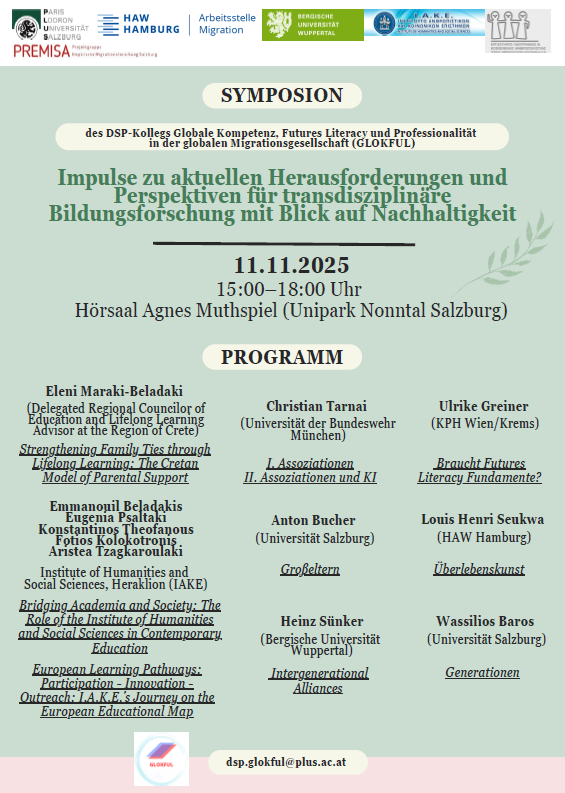
Programme
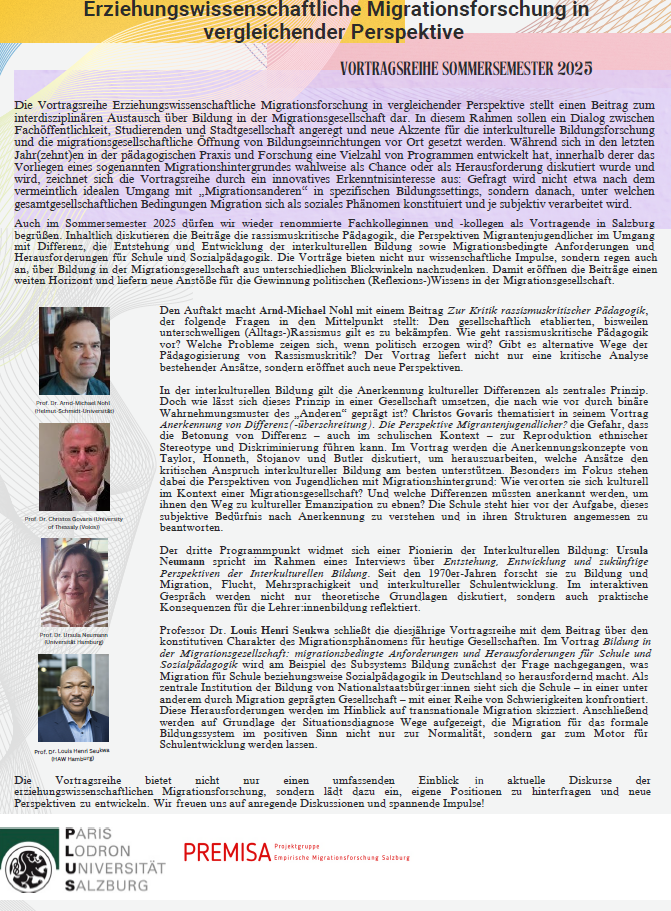
LECTURE SERIES SUMMER SEMESTER 2025
Educational research on migration
from a comparative perspective
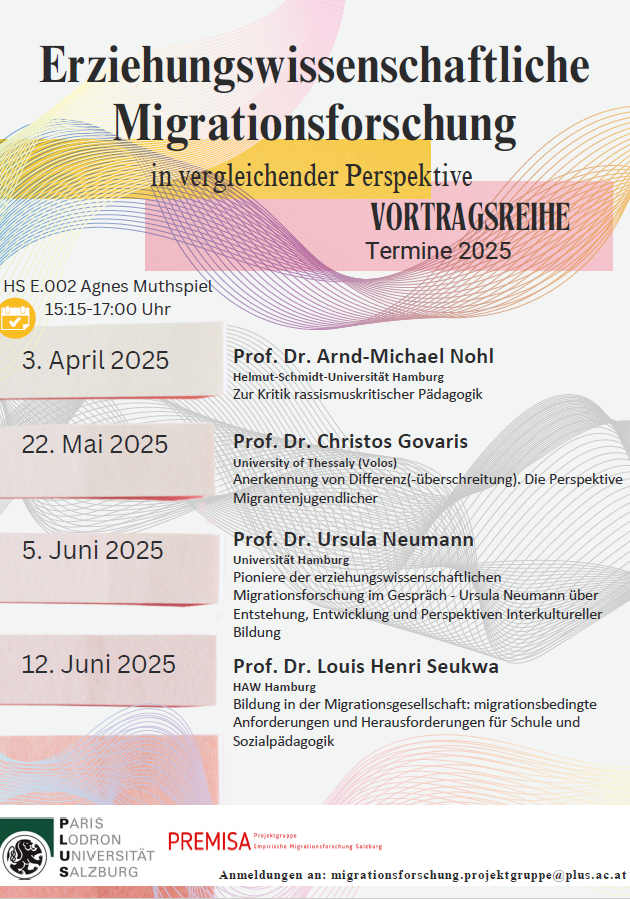
The lecture series ‘Educational Research on Migration from a Comparative Perspective’ contributes to interdisciplinary dialogue on education in a society of migration. Within this framework, the aim is to foster dialogue between experts, students and the wider community, and to set new priorities for intercultural educational research and the integration of migration-related issues into local educational institutions. Whilst a multitude of programmes have developed in educational practice and research over the past few years (and decades), within which the existence of a so-called migration background has been and continues to be discussed either as an opportunity or as a challenge, this lecture series is characterised by an innovative focus on understanding: The question is not so much about the supposedly ideal way of dealing with ‘those from a migrant background’ in specific educational settings, but rather about the broader societal conditions under which migration constitutes itself as a social phenomenon and is processed subjectively.
In the summer semester of 2025, we are once again delighted to welcome renowned experts as speakers to Salzburg. The presentations will explore anti-racist pedagogy, the perspectives of young migrants on dealing with difference, the origins and development of intercultural education, and the demands and challenges posed by migration for schools and social pedagogy.
The lectures not only provide academic insights but also encourage reflection on education in a migration society from various perspectives. In doing so, the presentations broaden horizons and offer fresh impetus for gaining political (reflective) knowledge within a migration society.
The lecture series not only offers a comprehensive insight into current discourses in educational migration research, but also invites participants to question their own positions and develop new perspectives.
We look forward to stimulating discussions and exciting insights!
……………………………………………………………………………………………………………………………………
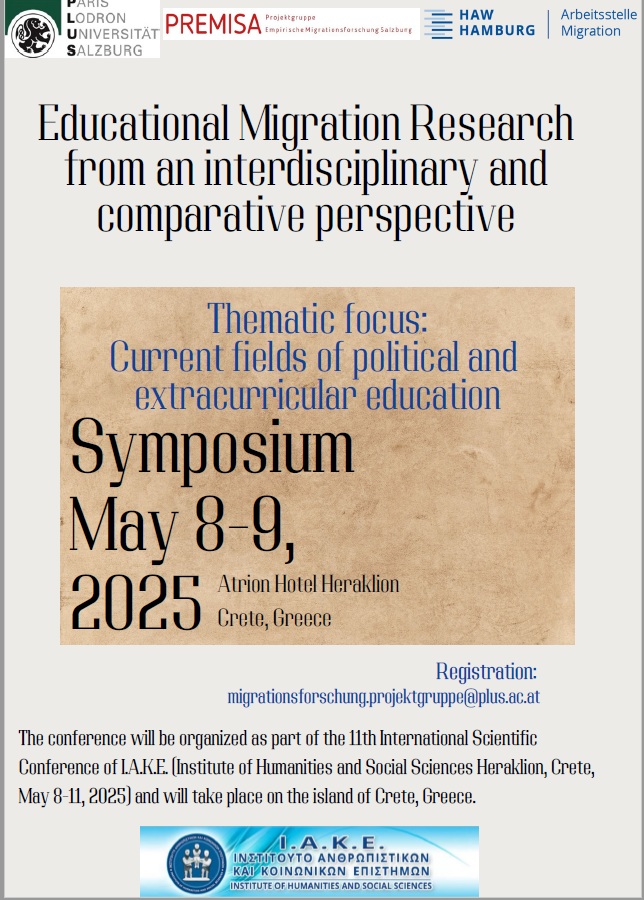
Symposium
Educational research on migration
from an interdisciplinary and comparative perspective
Heraklion (Crete), Greece, 8–9 May 2025, as part of the IAKE Congress
Theme: Current areas of political and non-formal education
Against the backdrop of increasingly heated political debates on migration, displacement and asylum, as well as the global rise of right-wing populist movements, the examination of migration and education in educational research and political education practice is more relevant than ever. This raises the question of what key challenges and tasks arise for educational migration research and political education in the context of social and political polarisation.
Social transformations – from global interconnectedness to digitalisation – are relevant to academic and educational engagement with the key issues of human rights, (global) justice, social inequality and conflict resolution between groups, and necessitate an interdisciplinary and comparative approach.
As part of the symposium ‘Educational Research on Migration from an Interdisciplinary and Comparative Perspective’, the aim is to explore areas of political and non-formal education from an interdisciplinary and international comparative perspective.
A key aim here is to examine different areas of educational practice as spaces for political reflection within a society of migration. Transdisciplinary perspectives can contribute to a deeper understanding of the challenges and opportunities in addressing migration within political education, and set new priorities for educational research and the opening up of educational institutions to a society of migration. To this end, the international symposium in Crete aims to create a forum for the interdisciplinary exchange of innovative approaches.
Information about the venue: Atrion Hotel, Heraklion (Crete), Greece
The conference is being organised as part of the 11th International Scientific Conference of the I.A.K.E. (Institute of Humanities and Social Sciences, Heraklion, Crete, 8–11 May 2025) and will take place on the island of Crete, Greece.
Further details regarding the venue will be announced in due course.
We look forward to welcoming you to Crete!
Entry fee: €50.00 (payable on the day)
Call for Papers Deutsch English
Supporting programme
In addition to the academic programme, there will be a varied social programme – cultural evenings and an excursion – organised in cooperation with the 11th International Scientific Conference of the I.A.K.E. (Institute of Humanities and Social Sciences, Heraklion, Crete, 8–11 May 2025).
On Sunday 11 May, we invite you to join us on an excursion, which offers the opportunity to explore the region and chat with other participants in an informal setting.
Further details on the social programme will follow!
Tickets for the cultural evenings and the day trip can be purchased on site.
Contact persons
Organisers:
Prof. Dr Wassilios Baros, Chair of Educational Research, Paris Lodron University of Salzburg, Department of Education, Erzabt-Klotz-Str. 1, 5020 Salzburg
Prof. Dr Louis Henri Seukwa, Chair of Educational Sciences, HAW Hamburg Department of Social Work, Alexanderstraße 1, 20099 Hamburg
Registration and paper submissions by email to the organising team:
Dr.in Aida Kell-Delić, BA MA
Annika Wastl, BA
Accommodation at the Hotel Atrion.
The symposium will take place on the hotel premises.
We look forward to seeing you there and hope you have a safe journey!