Risk, Hazard & Climate Lab
 About
About
The RISK, HAZARD & CLIMATE LAB aims to identify spatial risk, hazard and vulnerability patterns through geo-spatial analysis and remote sensing, integrating inter- and transdisciplinary approaches.
Global challenges – such as climate change and natural hazards – require an advanced spatial, temporal, and integrated understanding of potential harm in order to manage impacts and risks efficiently.
To measure, monitor, and represent the growing complexity of environmental and societal processes, the RISK, HAZARD & CLIMATE LAB develops and integrates innovative spatial methods and Earth Observation data to support science- and knowledge-based hazard and risk management.
With our research, we aim to contribute to the necessary transformation of society towards sustainability, equality, and more evenly shared well-being and happiness, while advancing disaster risk reduction in the face of climate change.
A particular focus is on Earth Observation (EO)-based mapping and monitoring of natural hazards and geomorphological features, using both knowledge-based and data-driven methods.
 Research
Methods
- Remote Sensing (Automated Feature Extraction, InSAR, Time Series Analysis, Data Cubes,…)
- Geospatial Analysis & Geostatistics
- Knowledge-based Approaches
- Machine Learning and Deep Learning Approaches
- Susceptibility, Vulnerability, and Risk Assessment
- Capacity Building
- User Requirements & Validation
Themes
- Disaster Risk Reduction
- Landslides, Floods, and other Natural Hazards
- Landscape Dynamics and Evolution
- Geomorphology and Landforms
- Climate Change Adaptation
The RISK, HAZARD & CLIMATE LAB addresses the following research questions:
- How can we increase our understanding of hazards and risks and assess their impacts on society and environment in a comprehensive and interdisciplinary manner?
- How to assess spatio-temporal dynamics of hazards and risks – stemming from climate change and other socio-ecological drivers – with novel geospatial methods?
- How can we best leverage remote sensing data to comprehensively map, analyze, and monitor landslides and other natural hazards and their impacts?
- How can we integrate geospatial technologies with natural and social sciences methods?
- How can geospatial knowledge about hazards and risks be employed to foster improved science-policy interaction?
- What are the appropriate ways to communicate and visualize hazards and risks to be relevant for decision-making?
- How can geospatial tools and methods be effectively used to create added value information and to raise awareness about hazards and risks?
 Our network
The RISK, HAZARD & CLIMATE LAB is embedded in an international network of research partners and friends. Engaging with a variety of network organisations, scientific partners as well as users ranging from public authorities to NGOs, we aim to achieve our research aims.
One of the main network partners of our lab is the Disaster Competence Network Austria (DCNA).

 Sustainable Development Goals
The RISK, HAZARD & CLIMATE LAB is committed to the UN Sustainable Development Goals and contributes through its science to the following specific goals:
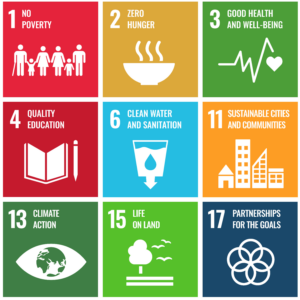
- SDG 1: End poverty in all its forms everywhere
- SDG 2: End hunger, achieve food security and improved nutrition and promote sustainable agriculture
- SDG 3: Ensure healthy lives and promote well-being for all at all ages
- SDG 4: Ensure inclusive and equitable quality education and promote lifelong learning opportunities for all
- SDG 6: Ensure availability and sustainable management of water and sanitation for all
- SDG 11: Make cities and human settlements inclusive, safe, resilient and sustainable
- SDG 13: Take urgent action to combat climate change and its impacts
- SDG 15: Protect, restore and promote sustainable use of terrestrial ecosystems, sustainably manage forests, combat desertification, and halt and reverse land degradation and halt biodiversity loss
- SDG 17: Strengthen the means of implementation and revitalize the global partnership for sustainable development
Follow us:
 LinkedIn – Risk, Hazard & Climate Lab Profile