MOLECULAR CANCER BIOLOGY
Oncogenic signaling, tumor–microenvironment interactions, spatial cancer biology and predictive biomodels mimicking human disease
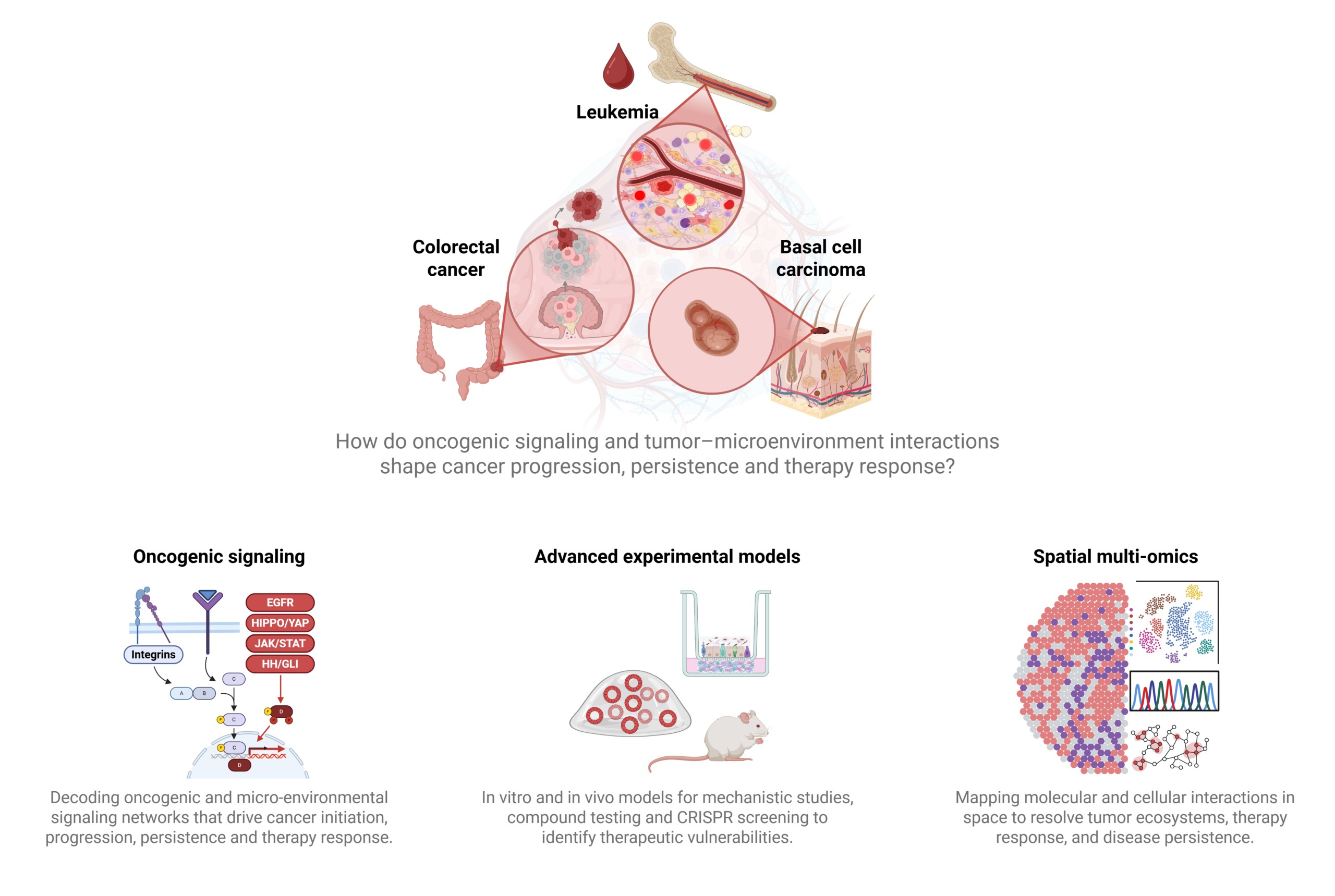
Cancer development and therapeutic resistance result from the interplay between oncogenic signaling within malignant cells and the surrounding tissue environment. Cancer cells communicate with immune, stromal and vascular cells, extracellular matrix components and specialized tissue niches, together forming dynamic tumor ecosystems that shape disease progression, metastatic spread and response to therapy. The Molecular Cancer Biology Lab investigates these mechanisms across solid and hematological malignancies, with major research activities in leukemia and myeloid neoplasms, gastrointestinal cancers and metastasis, and skin cancer. Our goal is to understand the molecular and cellular dependencies that enable malignant cells to grow, persist and evade therapy, and to exploit these dependencies therapeutically using advanced predictive organoid models closely mimicking human disease.
Research focus
Our research ranges from fundamental oncogenic signaling to the complex interactions between cancer cells and their microenvironment. We investigate pathways and their interactions including Hedgehog/GLI, JAK/STAT, EGFR and HIPPO/YAP, as well as adhesion-, integrin- and microenvironment-dependent signaling mechanisms. A particular interest lies in understanding how these pathways operate within the spatial and cellular context of a tumor. We study how immune and stromal cells, vascular structures and tissue-specific niches influence cancer stemness, metastatic colonization, immune escape and therapy persistence. In hematological malignancies, this includes the mechanisms by which leukemic cells interact with and exploit the bone marrow and lymphoid microenvironment. We also investigate how bacterial pathogens induce inflammatory memory that predisposes tissues to malignant transformation. Combining this knowledge will enable us to understand the behaviour of malignant cells and develop effective therapeutic strategies.
Advanced models and spatial multi-omics
To address these questions experimentally, we combine molecular cancer biology with advanced in vitro and in vivo disease models. These include genetically engineered human and murine models, as well as sophisticated organoid and multicellular co-culture systems and xenograft and humanized mouse models that reproduce key features of the human tumour microenvironment. A central focus is the development of predictive human biomodels that qualify as New Approach Methodologies (NAMs). These models can replicate patient-specific disease biology and drug response, thereby helping to reduce the notoriously high drug attrition rate and the need for animal experimentation.
From mechanisms to therapeutic vulnerabilities
A central goal of the lab is to translate mechanistic insight into new therapeutic concepts. We seek to identify vulnerabilities created by oncogenic signaling, cellular interactions and tissue-specific microenvironments that can be exploited to interfere with tumor growth, metastatic progression and disease persistence. Our research therefore connects molecular mechanisms, advanced experimental models and spatial cancer biology to develop rational strategies for overcoming therapeutic resistance and improving long-term disease control.
Our work is embedded in national and international research programs including EpiFlaMe, spaXio, TARGET-MPN, NuCaT, SENECA and the Cancer Cluster Salzburg, connecting basic cancer biology with technological innovation, computational approaches and translational cancer research. The Aberger lab is a member of the doctoral school PLUS “Biomolecules in Health and Disease” and a member of the “Center for Tumor Biology and Immunology” from the University of Salzburg.
Selected publications
- Elmer, D. P., Stockmaier, G., Grund-Gröschke, S., Strobl, V., Dang, H.-H., Wiederstein, M., Licha, D., Strobl, A., Eglseer, A., Sternberg, C., Tesanovic, S., Gruber, W., Wolff, F., Moriggl, R., Risch, A., Reischl, R., Huber, C. G., Krenn, P. W., Fortelny, N., … Aberger, F. (2025). Cooperative Hedgehog/GLI and JAK/STAT signaling drives immunosuppressive tryptophan/kynurenine metabolism via synergistic induction of IDO1 in skin cancer. Cell Communication and Signaling, 23(1), 91. https://doi.org/10.1186/s12964-025-02101-6
- Rathje, F., Sykora, M. M., Aberger, F., & Krenn, P. W. (2025). High Efficiency Lentiviral Transduction of Colon Organoids Using Reversible 2D/3D Culture Techniques. Methods in Molecular Biology (Clifton, N.J.), 2905, 245–254. https://doi.org/10.1007/978-1-0716-4418-8_16
- Stockmaier, G., Varkhande, S. R., Krenn, P. W., Hieu-Hoa, D., Sharma, A., Elmer, D. P., Steiner, M., Zaborsky, N., Neureiter, D., Greil, R., Horejs-Hoeck, J., Fortelny, N., Gratz, I. K., & Aberger, F. (2024). Hedgehog-Hippo pathway interactions promote T cell exclusion from the tumor microenvironment in basal cell carcinoma. BioRxiv, 2024.07.07.602398. https://doi.org/10.1101/2024.07.07.602398
- Krenn, P.W., and Aberger, F. (2023). Targeting cancer hallmark vulnerabilities in hematologic malignancies by interfering with Hedgehog/GLI signaling. Blood. 10.1182/blood.2021014761.
- Peer E, Aichberger SK, Vilotic F, et al. Casein Kinase 1D Encodes a Novel Drug Target in Hedgehog-GLI-Driven Cancers and Tumor-Initiating Cells Resistant to SMO Inhibition. Cancers (Basel). 2021;13(16).
- Rathje, F., Klingler, S., and Aberger, F. (2022). Organoids for Modeling (Colorectal) Cancer in a Dish. Cancers (Basel) 14, 5416. 10.3390/cancers14215416.
- Grund-Groschke S, Ortner D, Szenes-Nagy AB, et al. Epidermal activation of Hedgehog signaling establishes an immunosuppressive microenvironment in basal cell carcinoma by modulating skin immunity. Mol Oncol. 2020.
- Grund-Groschke S, Stockmaier G, Aberger F. Hedgehog/GLI signaling in tumor immunity – new therapeutic opportunities and clinical implications. Cell Commun Signal. 2019;17(1):172.
- Gruber, W., Peer, E., Elmer, D.P., Sternberg, C., Tesanovic, S., Del Burgo, P., Coni, S., Canettieri, G., Neureiter, D., Bartz, R., Kohlhof, H., Vitt, D., and Aberger, F. (2018). Targeting class I histone deacetylases by the novel small molecule inhibitor 4SC-202 blocks oncogenic hedgehog-GLI signaling and overcomes smoothened inhibitor resistance. Int. J. Cancer 142, 968-975. 10.1002/ijc.31117.
- Sternberg C, Gruber W, Eberl M, Tesanovic S, Stadler M, Elmer DP, Schlederer M, Grund S, Roos S, Wolff F, Kaur S, Mangelberger D, Lehrach H, Hache H, Wierling C, Laimer J, Lackner P, Wiederstein M, Kasper M, Risch A, Petzelbauer P, Moriggl R, Kenner L, Aberger F. Synergistic Cross-Talk of Hedgehog and Interleukin-6 Signaling Drives Growth of Basal Cell Carcinoma. International journal of cancer 2018. 10.1002/ijc.31724.
- Gruber W, Hutzinger M, Elmer DP, Parigger T, Sternberg C, Cegielkowski L, Zaja M, Leban J, Michel S, Hamm S, Vitt D, Aberger F. DYRK1B as therapeutic target in Hedgehog/GLI-dependent cancer cells with Smoothened inhibitor resistance. Oncotarget 2016; 7(6):7134-48.
- Kern D, Regl G, Hofbauer SW, Altenhofer P, Achatz G, Dlugosz A, Schnidar H, Greil R, Hartmann TN, Aberger F: Hedgehog/GLI and PI3K signaling in the initiation and maintenance of chronic lymphocytic leukemia. Oncogene 2015 34(42):5341-51.
- Pencik J, Schlederer M, Gruber W, Unger C, Walker SM, Chalaris A, Marié IJ, Hassler MR, Javaheri T, Aksoy O, Blayney JK, Prutsch N, Skucha A, Herac M, Krämer OH, Mazal P, Grebien F, Egger G, Poli V, Mikulits W, Eferl R, Esterbauer H, Kennedy R, Fend F, Scharpf M, Braun M, Perner S, Levy DE, Malcolm T, Turner SD, Haitel A, Susani M, Moazzami A, Rose-John S, Aberger F, Merkel O, Moriggl R, Culig Z, Dolznig H, Kenner L. STAT3 regulated ARF expression suppresses prostate cancer metastasis. Nat Commun. 2015 Jul 22;6:7736.
- Eberl M, Klingler S, Mangelberger D, Loipetzberger A, Damhofer H, Zoidl K, et al. Hedgehog-EGFR cooperation response genes determine the oncogenic phenotype of basal cell carcinoma and tumour-initiating pancreatic cancer cells. EMBO Mol Med 2012;4:218-33.
- Teperino R, Amann S, Bayer M, Mcgee SL, Loipetzberger A, Connor T, et al. Hedgehog Partial Agonism Drives Warburg-like Metabolism in Muscle and Brown Fat. Cell 2012;151:414-26.
- Schnidar H, Eberl M, Klingler S, Mangelberger D, Kasper M, Hauser-Kronberger C, et al. Epidermal Growth Factor Receptor Signaling Synergizes with Hedgehog/GLI in Oncogenic Transformation via Activation of the MEK/ERK/JUN Pathway. Cancer Research 2009;69:1284-92.