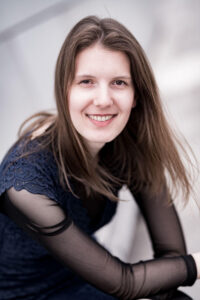
Natalie Stadler
| Department | Art History, Musicology and Dance Studies |
| PhD Supervisor | Prof. Dr. Nils Grosch |
| PhD Co-Supervisor | Prof. Dr. Nicole Haitzinger |
| Start | WS 2018/2019 |
| Contact | |
| Topic/Title | Music and dance in theater, exemplified within the Salzburg mystery play “Jedermann. The play of the rich man’s death” |
Abstract
Hugo von Hofmannsthal’s Jedermann is not only firmly associated with the Salzburg Festival and the city of Salzburg itself, but it is also one of the most fascinating theatrical phenomena in German language. Unlike the academic approach on music and dance, the history of the leading actors and directors is well documented. Overall, these topics have been and continue to be subject to constant marginalization within research, which has only begun to slowly diminish in the discipline of musicology in recent years. This dissertation addresses this lacuna in music and dance research and firstly attempts to summarize the approaches since its manifestation in ancient Greece. It then examines as a case study the versions of dance and music in 105 years of Jedermann history (1920 – 2025). What associations can be made between the art forms and what relevance do they have within the scenic events on stage?In order to approach the different concepts, this dissertation proposes four musical and five choreographic categories for differentiating between the artistic concepts of music and dance. Within this distinction, it will become apparent that the concepts of the first decades refer primarily to Max Reinhardt’s original staging concept. Dance mainly takes place during the Buhlschaft’s entrance and during the dinner party. In terms of sound, the concepts focus on the dramaturgically intended attempt to establish and distinguish between an earthly and a celestial connotation of music. It was not until 2013 that the directors Brian Mertes and Julian Crouch succeeded in freeing dance and music from this framework. They deliberately use elements of movement as dramatic elements throughout the entire play. The choreography thus became part of the “density of events taking place simultaneously”(1) . The collaboration with the composer Wolfgang Mitterer further opened the path to a multidimensional soundscape on stage that could be perceived by the audience.In summary, it becomes apparent through the detailed source analysis that the proposed categorizations within the performance history of Jedermann proves to be useful in addressing the artistic individuality of the various staging versions.(1) Brüstle, Christina. „Tönende Zeit-Räume. Aspekte der Inszenierung und Wahrnehmung von Klang“. In: Möglichkeitsräume. Zur Performativität von sensorischer Wahrnehmung. Christina Lechtermann [Hrsg.]. E. Schmidt Berlin, 2007. S. 163-171, hier: S. 163. Englische Übersetzung der Autor*in. Originaler Wortlaut: „Ereignisdichte des simultan stattfindenden Geschehens“.
.
© Hubert Auer