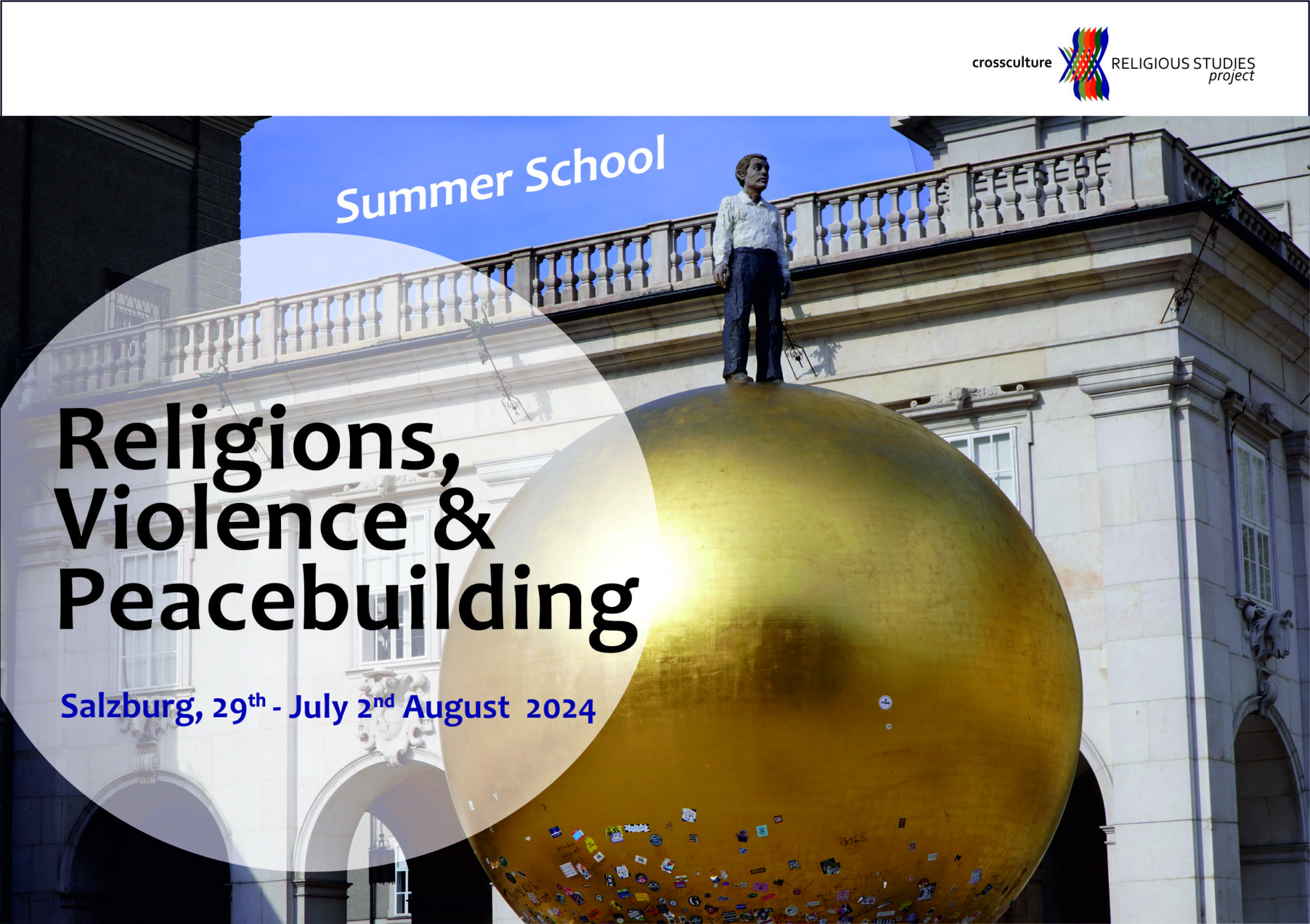
SummerSchool 29.07.2024 – 02.08.2024
Religion, Violence and Peacebuilding
at the Paris-Lodron University Salzburg.
In many places around the world, religions are once again being associated with violence. Religious ideas and ideologies play a direct or indirect role. At the same time, religions claim to bring peace. The SummerSchool examines the relationship between religion and violence and explores their potential for peacemaking. Experts from different specialist perspectives and religious backgrounds – such as Judaism, Islam, Christianity, Buddhism, Jainism and others – will offer a series of lectures. A peace-building workshop, the opportunity for student papers and plenty of space for intensive exchange also characterise the programme. A rich cultural programme rounds off the summer school.
Program
Monday 29.07.2024
09:00 Arrival10:30 Registration, Welcome and Introduction in HS 103 by Martin Rötting
11:00 Lecture 1: Dr. Martina Fischer: Two sides of the coin: The transformative and destructive potential of religion and faith-based actors in conflict
12:00 Lunch
14:00 Lecture 2: Wamae W. Muriuki: Buddhist Resistance to State Violence: The Case of Wartime Japan
16.00 Lecture 3: Soonil Hwang: Buddhist Ways of Dealing with Conflict
17:00 Debate Moderation Martin Rötting
19:30 Student party (Yard of the Faculty of Catholic Theology)
Tuesday 30.07.2024
9:00 Lecture 4: Grace Darling: Local conflicts in India
10:30 Group work
12:00 Lunch
14:30 Lecture 5: J.H. (Yossi) Chajes: The Overcoming of Biblically-Mandated Violence in Rabbinic Jewish Tradition in HS 101 in cooperation with https://www.salzburger-hochschulwochen.at/&ts=1712054021039
15:10 Lecture 6: Iqbal Ahnaf: Siege mentality and extremism in HS 101 in cooperation with https://www.salzburger-hochschulwochen.at/&ts=1712054021039
16.00 Coffee Break
16:30 Reflection
18:00 Supper
20:00 concert in the local residence or free evening
Wednesday 31.07.2024
9:00 Lecture 7: Edith Kayeli Chamwama: Case studies of peace building processes in Africa
10:30 student papers in HS 103:
10:30 Tabea Schünemann: Sunni Imam Muhammad Abu Zeid from Sidon, Lebanon
11:00 Denise Polaczuk: Religious Nationalism in the post cold war era – and today
11:30 Astrid Syifa Salsabila: “Romo Sandjaja, Doakanlah Kami”: Analysing the Relationship between Catholic and Muslim in Muntilan through the Discourse of Father Richardus Sandjaja
10:30 student papers in HS 109
10:30 Gichane Lucy: Wanjiku, A Still soft Voice. Silence of Femicide.
11:00 Felix Johne: On the relevance of transcendent concepts of reality in social work with addicts
11:30 Regula Hoch: Enemy becomes human. Israel/Palestine peace movements.
12:00 Lunch
14:00 Cultural Outing: Museum of Modern Art Salzburg: Breaking down Walls
19:30 Evening: Award Ceremony (in German) or free evening
Thursday 01.08.2024
9:00 Lecture 8: Fatimah Husein: Is interreligious dialogue effective for peacebuilding?
10:30 student papers in HS 103
10:30 Melli Fersi: Interreligious Learning Spaces
11:00 Alexandra Morath: Why religious pluralism is the basis for productive interreligious dialogue
11:30 Miriam Wambui: Kūhorohia: An Indigenous Model of Conflict Resolution and Reconciliation among the Agìkūyū in Kenya.
10:30 student papers in HS 109
10:30 Alina Knoflach: The individual significance of implicit religiosity for refugee migrants’
11:00 Jobins Antony: Dialogue of Life – A model for Co-Existence – context of India
11:30 Kalladayil Varkey Joseph: The Syro-Malabar Church and its Ecumenical Relations with other Christian denominations in Kerala
12:00 Lunch
14:00 Orinta Z. Rötting: workshop peacebuilding
17:00 Ulrich Winkler Award (UWA): Lukas Wiesenhutter: Job’s Encounter. Islamic and Christian Perspectives on Theodicy and Theodicy Sensitivity.
18:30 Evening: Sommerempfang Bischofsresidenz “Bishop + Tod”
Friday 02.08.2024
09:00 group work reflection
10:30 group work presentation and conclusion
12:00 Lunch
14:00 Departure
More information about the lectures:
Lecture 1: „Two sides of the coin: The transformative and destructive potential of religion and faith-based actors in conflict” by Dr. Martina Fischer, Policy Advisor for the protestant development agency “Brot für die Welt”
Faith-based actors are involved in many conflict zones around the globe. They have a potential for bringing antagonists at the negotiation table, and may support peace processes and reconciliation. However, faith-based actors may also contribute to violent escalation, by forging coalitions with politicians who instrumentalise religious diversity in hate speech and war propaganda. What is needed for enhancing constructive approaches? Is interreligious dialogue a remedy, and where are potentials and limits? What does reconciliation mean in different religious settings, and which preconditions are necessary?
Lecture 2: “Buddhist Resistance to State Violence: The Case of Wartime Japan” by Wamae W. Muriuki, University of Nairobi
While many Buddhist religious groups were coopted into Japan’s wartime militarism, as has been (in)famously documented in the case of Zen Buddhism, Japanese Shin Buddhists represented a small yet vocal locus of resistance to state propaganda. This presentation will document how this peace oriented stance was grounded in both deep religious commitment, and compassionate concern for all the communities bound up by Japanese state violence.
Lecture 3: Buddhist Ways of Dealing with Conflict by Soonil Hwang, Dongguk University Seoul
How does Buddhism approach conflict resolution? Are there specific methods within Buddhism for mitigating conflict? Fundamentally, Buddhism stands in opposition to conflict, violence, and killing under any circumstance. The teachings assert that engaging in violence or killing, regardless of one’s status, inevitably leads to dire consequences. Yet, our world is rife with innumerable and perpetual conflicts, almost as if violence were ingrained within human nature as a means of resolving disputes. In this presentation, I delve into various narratives within the life story of the Buddha, both past and present, to scrutinize his attempts at conflict resolution.
At times, the Buddha actively intervened in conflicts, striving to quell them, while in other instances, he found himself powerless to intercede, merely bearing witness to the unfolding violence. It appears that even the Buddha’s efforts had their limitations, ultimately leading to an acceptance of the world’s inherently conflict-ridden and violent nature. Through an analysis of diverse Buddhist tales, I explore the intricate Buddhist methodology for dealing with conflict, drawing insights from both the successes and limitations encountered by the Buddha and his disciples.
Lecture 4: Local conflicts in India by Grace Darling, Banaras Hindu University Varanasi
India being a country of diversity, witnessed so many events: pleasant as well as unpleasant events in the name of race, language and religions. One fierceful conflicts was the ethnic conflicts between the Nagas Indigenous people and the Kukis in the 1990s. Many were killed and displaced but there was a conflict resolution and peace was built through the initiatives of the Churches-the common ground they found. Forgiving bitterness, people are friends again and also worshipping God together again. But conflict resolution seems to be a more difficult task when it happens between entirely two different communities with lesser strong common ground like the present fierce conflicts in Manipur India between the Meiteis and the Kukis ethnic Community. With the even ever increasing advanced arms and ammunitions and with great loss of lives and property continuing on both the sides and uncertain future, there is a greater need for research for peacebuilding to be practical.
Lecture 5: The Overcoming of Biblically Mandated Violence in the Jewish Tradition by J.H. (Yossi) Chajes, University of Haifa, in HS 107
The Jewish tradition — technically speaking, the rabbinic tradition that establishes what is called “Judaism” and which is known in emic terms as “the Oral Tradition” — might be described as a courageous and even audacious attempt of the ancient rabbis to read and implement the Bible in a manner consistent with their own ethical ideals. This, even when doing so required them to assert readings that clearly contradicted the plain sense of Scripture. In this session we will explore the ways in which rabbinic morality and commitment to the sanctity of human life led to the neutralization of biblical justification of holy wars and their concomitant genocides.
Lecture 6: Siege mentality and extremism: challenges and paths in religious peacebuildin by Mohammad Iqbal Ahnaf, Gadjah Mada University Yogyakarta, in HS 107
Some years ago, coming from the majority Muslim region of Java, I met a woman pastor in a Christian majority community of Indonesia’s peripheral region of East Nusa Tenggara. The pastor was one of prominent local advocates of inter religious tolerance in Christian majority regions of Indonesia. I was moved by her worry of what she called ‘intensifying diversity.” Her fear reflects a pressing issue of siege mentality that shapes views and attitudes toward religious others. Migration that brought more diversity has reached more rural communities and often caught them unprepared for multidimensional impacts of demographic changes. Siege mentality finds reference in religious narratives that can develop into extremist minds when they manifest in histories and socio-psychological realities of individuals living in diverse communities. Based on my peacebuilding experience in Indonesia, this presentation will highlight this challenge and offer paths for peacebuilding in multi-religious religious community.
Lecture 7: Case studies of peace building processes in Africa by Edith Kayel Chamwama, University of Nairobi
History is replete with conflicts that have taken place on the African continent. The causes and effects of these conflicts have ranged from personal to communal, ethnic to national, intra to inter-state, and religious to political among many others. Within all these conflicts, the desired outcome has always been peace and reconciliation. As a result, there have been various attempts and strategies to bring about peace and reconciliation. It is against this backdrop that we will discuss the peace-building process in Africa. Recognizing the complexity of this topic and not trying to make a generalization, this discussion offers a glimpse of the peace-building process in Africa by presenting case studies selected from various sections of the continent. This discussion is predicated on the concept that peacebuilding encompasses a spectrum of policies designed to lower the risks of slipping into conflict, providing the foundation for enduring peace and development, and enhancing national capacity. These policies are converted into strategies that lead to achieving the desired peace and reconciliation. The resultant strategies are tailored to specific country or context needs, which is why we use case studies in this discussion. The case studies attempt to highlight the factors driving the conflicts and the strategies that have been employed in the peace-building process. Data for this discussion will be gathered from secondary sources.
Lecture 8: Is interreligious dialogue effective for peacebuilding? by Fatimah Husein, Gadjah Mada University Yogyakarta
Interreligious dialogue has often been claimed as a method in preventing or overcoming conflicts involving people of different religious and faith backgrounds. Some argued that the international community has only two choices: dialogue or death (Knitter, et. al, 1991). This could be strengthened with the findings from the Society for the Study of Conflict, which, in 2015, reported that victims of religious-based conflict or conflict instigated by religious related issues in 2011 – 2013 are higher than the total number of World War I and II combined.
The question is: “Is religion killing us? Is there any hope for the future of interreligious relationships? And, is interreligious dialogue effective for peacebuilding?” This session will discuss those questions with particular examples and cases from Indonesia, which, being the biggest Muslim country in the world, has more than 35 millions adherents of faiths and religions other than Islam.
Ulrich Winkler Award: Lukas Wiesenhutter: Job’s Encounter. Islamic and Christian Perspectives on Theodicy and Theodicy Sensitivity.
Text coming soon…