Master Thesis
… and prerequisite (formal) steps towards graduation.
A master thesis is the key milestone on the road towards graduation. It helps to get off with an early start towards identifying a suitable topic, certainly long before all course work is completed.
First, though, you need to make sure that all prior steps are completed – please check out the guidelines document at the bottom of this page.
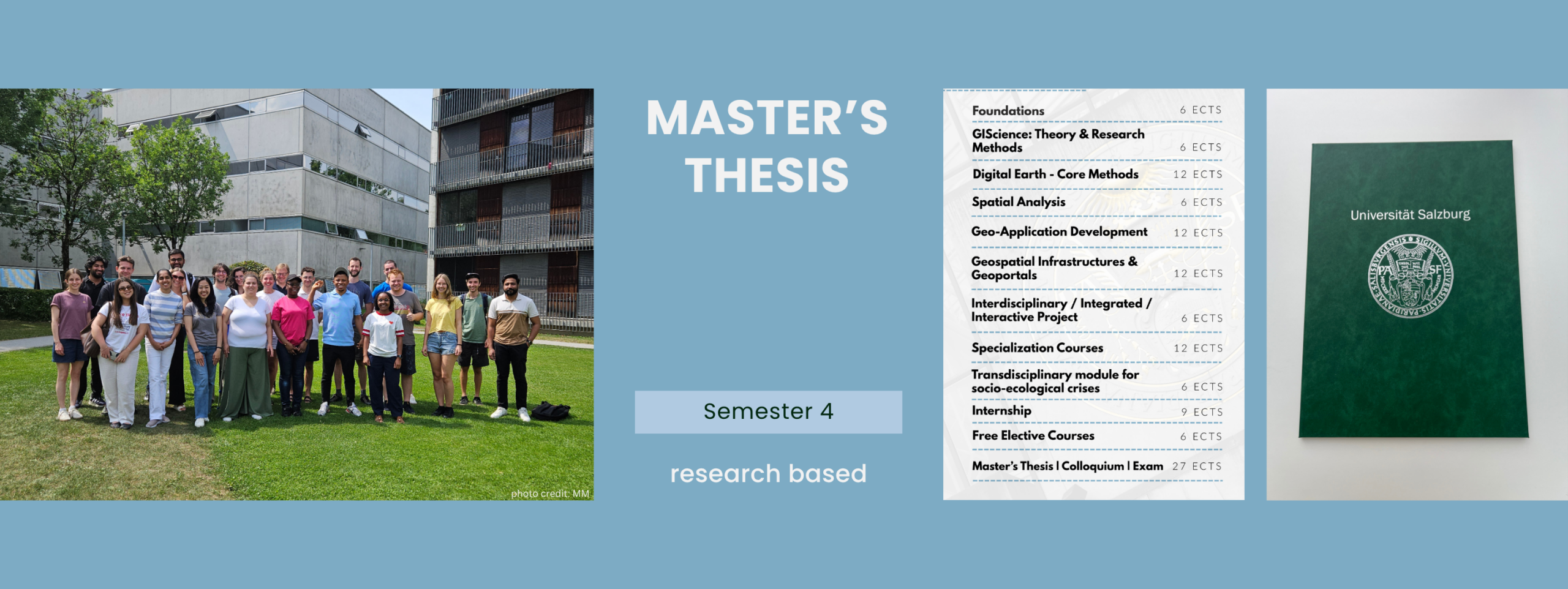
Development of your Master Thesis typically will start in the second year, and will be the main task throughout the final semester. Topics are discussed, defined and agreed with the chosen supervisor, who will be a professor at the University of Salzburg. If anyone from outside University of Salzburg, or without ‘habilitation’ (not a ‘Dozent’, ‘PD’, ‘Associate Prof’ or ‘Prof’) is considered as supervisor, explicit written permission must be granted before starting with the thesis.
A collection of topic ideas offered by Z_GIS faculty is provided here. Generally, you should choose a topic suiting your interests and intended (future) professional orientation. Sometimes MSc thesis topics are announced and offered within project frameworks, but currently a majority of topics is chosen based on the candidate’s suggestions and interests.
Further general and faculty students ‘Forms and Guidlines’ information can be found at Leitfäden für Studierende (e.g. cover sheet) and specifically for Applied Geoinfomatics degree programs.
Overview of recent thesis topics:
Students choose to publish their thesis at e-PLUS, all theses are listed in the library catalogue and may be available free to read (including Open Access).
- Intercomparison of chlorophyll-a concentration estimation models in inland waters using Sentinel-2 MSI satellite imagery : a case study of Lake Balaton and Lake Geneva
- Spatial patterns of socially sustainable mobility : expanding a set of indicators to further include social aspects
- Cultural heritage and landscape patterns in the highlands of the Kotayk region, Armenia
- Development of a generic ABM-GeoAI framework for a GeoAI-enhanded agent decision making
- Aspect-based emotion analysis of geo-social media data using BERT
- An approach for multi-purpose semantic enrichment of Sentinel-1 imagery
- Analyzing public perception on the Russia-Ukraine War in the US : a geo-social media analysis employing topic modeling and emotion analysis
- Evaluating the effectiveness of categorical time-series based on semantic earth observation workflows in land cover monitoring : a case study of Kanthuni, Makueni County, Kenya
- Identifying the environmental predictors of stress in cyclists through point-of-view video data and street view images using a novel computer vision approach
- Conceptualization of a spatial ESG framework for the real estate sector: Derivation of spatial ESG indicators & leveraging geospatial data for its assessment
- Sentinel-2 multitemporal approaches for tree species classification: Mapping a riparian forest composition
- Spatial and temporal characteristics and driving mechanisms of recreational ecosystem services supply-demand mismatch based on multi-source data : evidence from the Yangtze River Delta
- Salzburg-Dengue ABM: a prototypical agent-based modelto simulate a dengue infection via Aedes albopictus, in Austria
- Global bikeability benchmarking: comparative analysis of 100 cities worldwide using NetAScore
- DEM super-resolution constrained by topographic knowledge in high mountain areas
- Knowledge driven detection and feature analysis of typical terrestrial volcanoes
- Impact of public transit accessibility on real estate valuation on the example of Salzburg and its metropolitan area
- A global-scale landform classification derived from seafloor morphology
- Extraction model of linear dunes developed on undulating terrain and dune characteristic analysis : a case study of Australian dunes
- Analysis of the attraction space characteristics and formation mechanisms of internet-famous tourist cities based on deep learning
- Fine-scale population distribution modeling in central urban area based on machine learning
- GIS-based assessment of transportation network resilience under hazard scenarios
- Temporally dynamic ecosystem service assessments using web-services
- Rock glacier movement estimation and classification based on InSAR analysis in the Austrian Alps
- Cycling infrastructure assessment in Salzburg : analyzing mobility data to identify missing and insufficient bike infrastructure